When What Burns Seems Cleaner Than What Produces No Smoke
In western Massachusetts, a young man decided to take a closer look at what he was smoking. He was already a smoker, but he distrusted e-cigarettes because of the “chemicals.”
After doing his own research, he arrived at an unexpected conclusion: conventional cigarettes seemed like the safer choice. “I researched it,” he told Jamie Hartmann-Boyce, who recounted the story during a conversation on the podcast Let’s Talk E-Cigarettes.
On the package, he found something that appeared to confirm his decision: “Tobacco ingredients: tobacco and water.” A vape, by contrast, looked to him like a small pharmacopeia of chemical names.
The sentence had the neutral appearance of technical information. Its history, however, was regulatory. In 2015, the F.D.A. warned the Santa Fe Natural Tobacco Company that terms such as “natural” and “additive-free,” used to market Natural American Spirit cigarettes, could lead consumers to believe that the product was less harmful. Two years later, an agreement prompted the company to abandon those advertising claims, though “Natural” remained in the brand’s name.
A more restrained formulation remained as well: “Tobacco ingredients: tobacco and water.” Consumers in several states had already sued the manufacturer over similar claims. The explicit promise of a healthier cigarette disappeared; in its place was a sentence that promised almost nothing and, for precisely that reason, could suggest a great deal. The rest was left to the person reading the package.
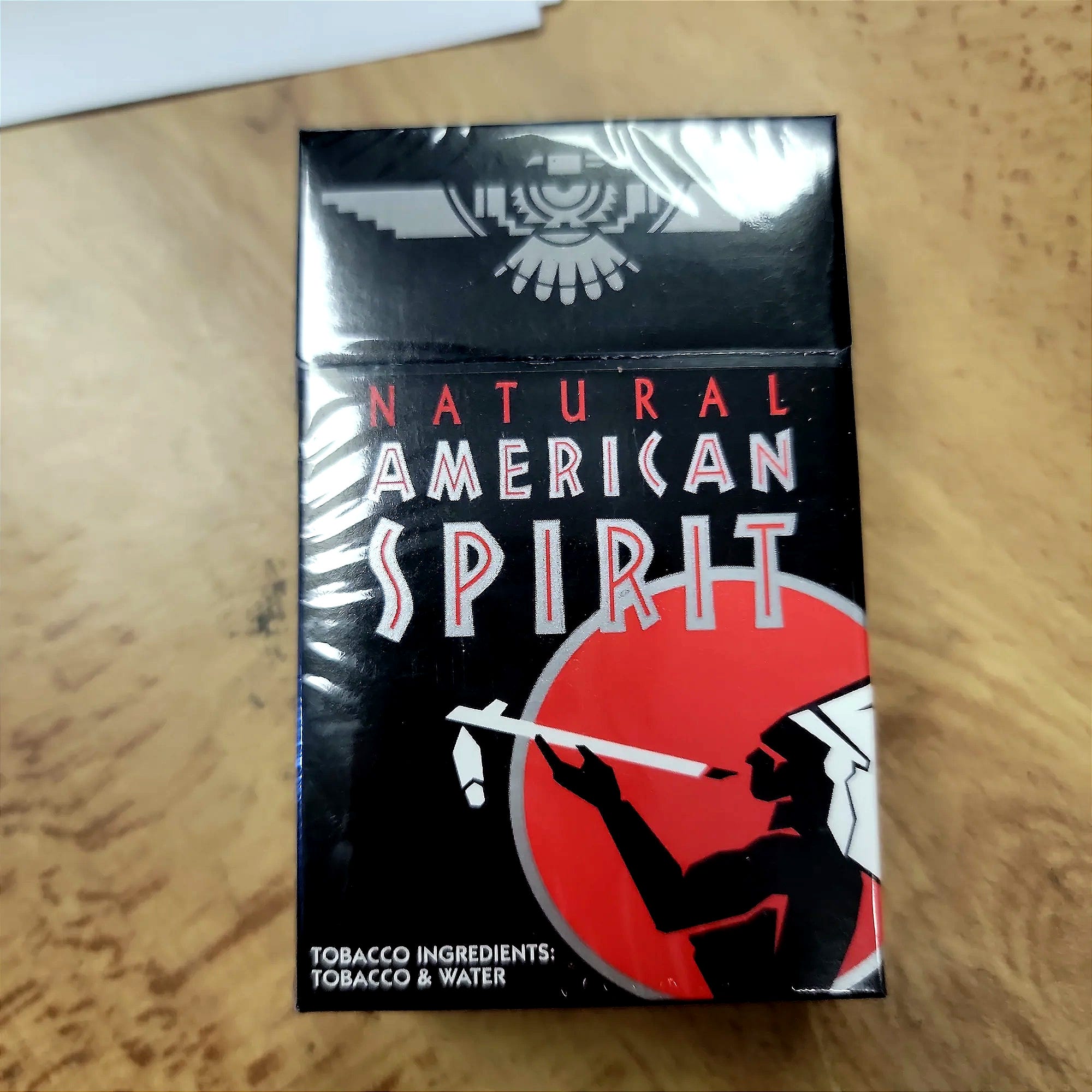
The young man’s mistake lay not exactly in his reasoning but in the references that fed it. Tobacco and water belonged to the vocabulary of the familiar, of things found in nature. The names of compounds in vaping liquids did not. One product seemed legible; the other, suspiciously chemical.
But he had not invented this language. He had learned to distrust it, in part, from the very people who said they were protecting him from the harms of tobacco.
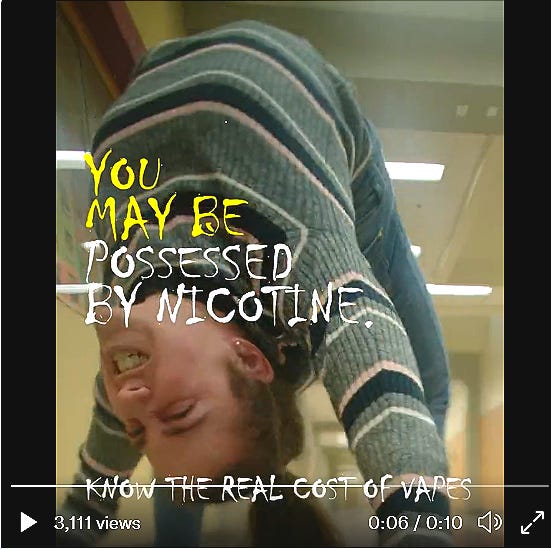
Advertising has long exploited the opposition between the natural and the artificial. In the United States, however, that rivalry acquired a new source of authority when adolescent vaping became a central focus of prevention campaigns. To make difficult-to-represent risks visible, some campaigns gave physical form to the substances inside the devices: onscreen, chemical compounds took on threatening, literally monstrous shapes.
There was a real problem to address. E-cigarettes are not harmless, and exposure to nicotine and components of their aerosol carries risks that vary with age, patterns of use, and health status. But public campaigns teach more than their slogans intend. In naming one threat, they also give the public a vocabulary for recognizing others. “Chemical” could cease to be a description and begin to function as a warning sign.
The familiar then gained a quiet advantage. Leaf, soil, water: old, almost domestic words. The names of compounds: strange, technical, opaque. Cigarettes could seem simpler not because they caused less harm but because they did not display the signs that consumers had learned to associate with danger.
This possibility did not rest on anecdote alone. Over the past decade, national surveys have recorded an increase in the proportion of Americans who consider e-cigarettes as harmful as combustible cigarettes, or even more harmful. Experimental studies began to show that certain messages could alter that comparison as well.
When researchers isolated the effect in the laboratory, it appeared.
In a randomized experiment, adult smokers exposed to an F.D.A. anti-vaping advertisement —Vaping Is an Epidemic— came to view e-cigarettes as more harmful and less useful for quitting smoking. They also became less willing to switch from cigarettes to vaping.
A meta-analysis of twelve studies found a similar movement: prevention messages tended to heighten perceptions of the harms of vaping, even when cigarettes were the point of comparison. The effect was far from universal. In Vermont, for example, one trial detected no change. Communication could shift perception; it did not always do so, or do so in the same way.
These studies captured only one part of the argument. They showed that anti-vaping messages could bring the perceived risk of vaping closer to that of smoking. They did not demonstrate the next step: that, once the two risks had been drawn together, a cigarette presented as “natural” would begin to seem safer.
It is at this second juncture that the work of Stefanie Gratale becomes relevant. In an experiment published in 2019, Dr. Gratale and her colleagues compared Natural American Spirit advertisements from before and after the restrictions imposed two years earlier. The new language corrected some misconceptions, but not all of them. Beliefs about the product’s composition and possible effects persisted. When references such as “tobacco and water” and “chemical-free” were also removed, those interpretations declined more consistently.
The phrase read by the young man in Massachusetts, then, was not merely a curiosity of packaging. Formulations of this kind had already produced measurable effects on what consumers believed they were buying.
Decades of marketing had exploited the proximity between “natural” and “safe.” Campaigns that turned the “chemicals” in vaping into a sign of danger may have added another layer. The studies do not allow us to say that one caused the other. They do allow us to say that the two references can meet in the consumer’s mind.
Ingredients, Before the Fire
Stefanie Gratale, a professor at the Rutgers School of Public Health and a researcher at the Rutgers Institute for Nicotine and Tobacco Studies, described on the same podcast what she had heard in focus groups with adolescents and young adults who were shown advertisements for cigarettes and cigarillos.
Confronted with terms such as “organic,” “simple,” or “tobacco and water,” participants arrived on their own at the same word: natural. It did not even have to appear in the advertisement.
E-cigarettes and nicotine pouches, on the other hand, evoked industrial processes and substances that were difficult to recognize. For some participants, the paradox was completed there: what was destined to be burned looked cleaner than what produced no smoke.
Focus groups cannot tell us how many people think this way, nor can they establish where the perception originated. They serve another purpose: they make the reasoning visible as it unfolds.
Caitlin Weiger and her colleagues reached the same problem by a different route. In a survey of American adults, they asked not only how harmful vaping seemed in comparison with smoking but why.
Among those who considered it equally or more harmful, one of the most frequent answers fit into a single word: chemicals, substances imagined as dangerous inside the device.
This helps explain the power of a phrase such as “tobacco and water.” It need not say that a cigarette is safer. It need only make one product intelligible and the other opaque. A short list of ingredients suggests simplicity; simplicity can take on the appearance of purity; and, in the consumer’s imagination, the distance between purity and safety is short.
None of this, however, reaches the fire.
A peach grown with fewer pesticides remains a peach. A cigarette made from organic tobacco will be burned. It is in that combustion—not in the leaf’s natural appearance—that many of the toxic and carcinogenic substances in smoke are formed. The origin of the tobacco and the length of the ingredient list do not interrupt this process.
Familiarity is not toxicology.
When the Hierarchy Began to Disappear
The phenomenon did not remain confined to experiments or focus groups. National surveys began to register the same change at the population level.
In 2012, 11.5 percent of adults interviewed for the Tobacco Products and Risk Perceptions Survey considered e-cigarettes as harmful as conventional cigarettes. Three years later, that figure had risen to 35.7 percent. The proportion who judged them more harmful also grew, from 1.3 percent to 4.1 percent.
Another large national survey, the PATH Study, recorded a similar movement. Between 2013–14 and 2015–16, the proportion of adults who considered vaping less harmful than smoking fell from 41.1 percent to 25.3 percent. Jidong Huang and his colleagues extended the series through 2017 and found the same pattern. Gradually, the hierarchy of risk between the two products was beginning to dissolve in the public mind.
The surveys trace the curve. On their own, they do not explain what pushed it. Ideological alignments, news coverage, prevention campaigns, concern about youth vaping, distrust of the industry, and changes in the products themselves may all have acted at once. It is entirely possible to learn, correctly, that vaping is not harmless and then make the mistaken leap to the conclusion that its risks are equivalent to those of smoke.
In 2019, however, the curve broke in a different way.
The outbreak of lung injuries that would become known as EVALI brought vaping to the center of American news coverage before its cause had been established. The urgency was real: young people were arriving at hospitals with severe respiratory failure, some of them requiring mechanical ventilation. But the language used to describe the crisis was broader than what the investigation would eventually support.
During the first months, regulated nicotine products, illicit THC cartridges, and mixtures of unknown origin circulated publicly under a single word: vaping. The category was understandable while the cause remained open. It became harder to defend as the evidence narrowed. When researchers analyzed material collected directly from patients’ lungs, they found a pattern that health authorities could not ignore. Vitamin E acetate appeared in forty-eight of the fifty-one cases examined and in none of the ninety-nine healthy controls; the vast majority of patients also had laboratory evidence of, or reported recent use of, products containing THC. The outbreak looked less and less like a disease caused by vaping as a technological category and more and more like a poisoning associated with adulterated THC cartridges, particularly those obtained on the informal market.
Public messaging, however, narrowed the category more slowly than the scientific investigation did. The word had already organized the fear.
Dhaval Dave and his colleagues treated the beginning of the crisis as an information shock. They estimated that the first alert raised, by roughly sixteen percentage points, the proportion of Americans who considered e-cigarettes more harmful than combustible cigarettes. When authorities began to emphasize the role of THC-containing products and informal sources, some of that perception receded.
Only some of it.
The evidence corrected the etiology faster than public opinion corrected its memory.
The gap did not remain confined to the first days of uncertainty. A later analysis of state health-department websites found that, even after vitamin E acetate had emerged as the outbreak’s central link, many authorities continued to recommend avoiding all vaping products indiscriminately, and few clearly explained the role of adulterated THC. The initial caution had become, in part, a category resistant to the very evidence that had made it necessary.
The effect appeared in the curve. Between 2018 and 2020, the proportion of American adults who considered vaping more harmful than smoking rose from 6.8 percent to 28.3 percent. In a longer series, covering 2012 through 2022, Alexander Wu and his colleagues found an especially abrupt change around EVALI: roughly twelve percentage points. The F.D.A.’s anti-vaping campaign, launched the previous year, had also coincided with an inflection, estimated at 3.5 points.
But EVALI was something else. It did not merely add another message about risk. It visually associated an entire category of products with damaged lungs, hospitalizations, and death.
The epidemic subsided. The association remained.
The Word That Organizes Danger
The data show that perception changed. Caitlin Weiger and her colleagues wanted to know how people explained that change to themselves: Why would someone consider vaping as harmful as smoking, or more so?
In a survey of American adults who smoked, used e-cigarettes, or did both, some participants answered in their own words. Among those who considered vaping equally or more harmful, one justification appeared frequently: “harmful chemicals,” mentioned by between twenty-nine and thirty-three per cent of respondents, depending on the group.
Among those who recognized vaping as less harmful, the vocabulary was different. Vapor was not smoke; exposure to certain harmful substances was lower; there was no combustion. Their health had improved.
The difference lay not only in how much risk each group attributed to the products. It also lay in where they looked for that risk. Some looked at the ingredients. Others looked at the process.
This contrast helps explain why “chemicals” is such an effective word in health communication. In an experiment involving 2,801 adults, Daniel Owusu and his colleagues compared messages focused on harmful substances, uncertainty about ingredients, distrust of the industry, and financial cost. The message about “harmful chemicals” was perceived as the most informative and effective, and it elicited the strongest negative emotional response.
The word works. For that very reason, it matters to notice what it can obscure. An ingredient list is visible; the process that transforms the product is less so. Cigarette smoke is also chemical matter, but much of the problem begins when the product is lit.
The reply that “everything is chemistry” is not especially helpful. In ordinary speech, “chemical” rarely names a neutral scientific category; it tends to identify whatever seems manufactured, opaque, or contaminating.
A different question reorganizes the problem: How does this product cause harm? With cigarettes, the answer begins with combustion.
What a Message Can Do
A historical curve does not prove that campaigns caused the change. Experiments permit a narrower question: Can a message, in isolation, alter the comparison between vaping and smoking?
Leslie Sawyer and Thomas Brandon exposed 161 daily smokers either to an F.D.A. advertisement intended to prevent youth vaping —Vaping Is an Epidemic— or to a control video with no content about e-cigarettes. Afterward, participants who saw the advertisement rated vaping as more harmful and less useful for quitting smoking. They also reported less willingness to replace cigarettes with an electronic product.
Haijing Ma and her colleagues brought together twelve experiments involving 6,622 participants. On average, prevention messages increased perceptions of vaping risk. When the measure specifically concerned relative harm compared with smoking, the effect was present but small: d = 0.14.
Not every study found a change. In Vermont, Andrea Villanti and her colleagues randomly assigned 569 young adults to receive either messages about vaping-related harm and dependence or messages about sun protection. Across the full sample, there was no detectable effect on beliefs, perceptions of harm, or behavior, either immediately after exposure or a month later. More than seventy per cent of participants already considered vaping as harmful as smoking, or more so, leaving little room for that perception to move further.
The experiments cannot, on their own, attribute a decade-long transformation to public campaigns. But they make it difficult to regard those campaigns as innocent bystanders. In experiments, anti-vaping language compresses the perceived distance in risk between the products. In Gratale’s groups, “chemicals” and artificiality are associated with danger, while familiarity and simplicity favor interpretations of lower harm. None of these studies proves that a particular campaign led the young man in Massachusetts to choose cigarettes. Taken together, however, they make it increasingly difficult to treat the phenomena as entirely disconnected. Faced with the two alternatives, he reproduced exactly the grammar threaded through both sets of messages.
Perhaps this is the campaigns’ most consequential effect. They did not need to say that cigarettes were safe. It was enough to make the alternative sufficiently frightening. When the perceived difference between smoking and vaping contracts, cigarettes do not have to improve in order to regain ground.
They need only appear no worse.
Who Was Already Speaking This Language
The campaigns found ground already prepared by advertising and promotion. Long before vaping entered the contest, cigarettes presented as natural, organic, or additive-free had led consumers to infer that they were less harmful.
The experiments by Gratale, Maloney, and Cappella demonstrated the persistence of this association in Natural American Spirit. Even after the 2017 restrictions, formulations such as “tobacco and water” remained capable of sustaining mistaken interpretations of composition and risk.
Anti-vaping communication, then, did not need to invent the opposition. It found an old language—nature on one side, chemistry and industry on the other—and may have given it a new function. A practice once used to sell cigarettes came to coexist with another practice, used to warn against vaping.
The opposition, of course, did not belong to tobacco alone. For decades, the markets for food, cosmetics, and other products have linked nature, simplicity, and purity with trust. Gratale describes advertisements featuring tobacco leaves, fields, water, and earth tones. The packaging visually returns the industrialized product to the land: the factory disappears; the plant remains.
In this setting, the cigarette industry did not have to claim that its product was safe. It needed only to occupy the familiar side of the comparison.
This does not require consumers to have forgotten that smoking causes disease. The distortion can be narrower and, for that reason, more plausible. Someone can know that cigarettes are harmful and still regard an “organic” cigarette, or one presented as “tobacco and water,” as less dangerous than an e-cigarette. The knowledge of harm remains. What becomes confused is the ordering of the risks.
Even so, responsibility is not distributed simply. Companies may commercially exploit an aura of purity, but they also respond to regulation, market competition, and shifts in public perception. Health authorities work under the pressure of urgency, political demands, institutional priorities, prevention targets, and scientific uncertainty.
This does not make the two sides equivalent. It makes the circulation of language harder to attribute to a single intention. An expression can begin as a commercial strategy, reappear as a health warning, and, in both cases, reinforce the same association between “chemical” and danger.
The point is not to decide who spoke first, or with better intentions. It is to observe what happens when languages produced by different institutions begin to organize risk in the same way.
The Cost of Erasing the Hierarchy
Nicola Lindson, a researcher at the University of Oxford and one of the podcast’s hosts, moved the discussion onto more complicated ground: What happens when a message about risk becomes policy?
Restrictions on flavors, disposable products, or certain categories of e-cigarettes may pursue legitimate aims, including reducing initiation among young people who have never smoked. But markets and behavior do not remain still as rules change. People substitute products, combine forms of consumption, turn to informal sources, postpone attempts to quit, or return to whatever remains available. An intervention rarely produces only the behavior it was designed to produce.
Counting how many people stop vaping, then, is only part of the answer. We need to know who stopped, what they had used before, and, above all, what they did next.
A decline in vaping among adolescents who have never smoked may represent a clear benefit. For someone who has smoked for twenty years, who uses cigarettes and e-cigarettes simultaneously, or who is on the verge of leaving combustion behind, the same policy may produce a different trajectory. Benefits and costs do not necessarily appear in the same populations, or at the same time. Dependence, income, access to treatment, prior experience, and availability all shape the response.
E-cigarettes are not harmless, and their uptake among people who do not smoke is a legitimate public-health concern. This does not erase the fundamental difference between vaporizing a product and burning tobacco. The absence of combustion reduces exposure to many of the toxic constituents produced by smoke, and Cochrane reviews have found evidence that nicotine e-cigarettes can help some adults quit smoking.
The difficulty lies in communicating both facts at once without allowing one to erase the other.
Alexander Wu and his colleagues confronted this tension while examining changes in risk perception in the United States. Campaigns designed to discourage youth initiation can produce effects beyond their intended audience when they compress the differences among products too severely. The problem is not in saying that vaping carries risks. It is in turning a truthful warning about one product into a misleading comparison between different products.
For someone who has never used nicotine, avoiding all of these products may be a simple and desirable answer. For someone who already smokes, the choice usually takes place within a narrower set of possibilities: continuing, trying to quit, cutting down, combining products, or substituting one for another.
In this context, “use nothing” may describe the ideal destination without describing an available route. When alternatives with different risk profiles begin to look equivalent, the less harmful option does not necessarily prevail. The winner may be the more familiar product, the more accessible one, the one that requires less relearning—or simply the one already in a person’s pocket.
In western Massachusetts, a young man believed that he was doing exactly what public health so often asks people to do: he sought out information and compared the products in front of him.
On one side, he read “tobacco and water.”
On the other, he saw chemicals.
And he chose the fire.
Jamie Hartmann-Boyce and Nicola Lindson examine emerging evidence on electronic cigarettes and speak with Stefanie Gratale of the Rutgers School of Public Health in the United States. Produced by University of Oxford Podcasts, the episode complements Cochrane’s living systematic review of electronic cigarettes.
Let’s talk e-cigarettes, July 2026.
Bandi, P., Asare, S., Majmundar, A., Nargis, N., Jemal, A., & Fedewa, S. A. (2022). Relative harm perceptions of e-cigarettes versus cigarettes, U.S. adults, 2018–2020. American Journal of Preventive Medicine, 63(2), 186–194. https://doi.org/10.1016/j.amepre.2022.03.019
Blount, B. C., Karwowski, M. P., Shields, P. G., Morel-Espinosa, M., Valentin-Blasini, L., Gardner, M., Braselton, M., Brosius, C. R., Caron, K. T., Chambers, D., Corstvet, J., Cowan, E., De Jesús, V. R., Espinosa, P., Fernandez, C., Holder, C., Kuklenyik, Z., Kusovschi, J. D., Newman, C., ... Pirkle, J. L. (2020). Vitamin E acetate in bronchoalveolar-lavage fluid associated with EVALI. The New England Journal of Medicine, 382(8), 697–705. https://doi.org/10.1056/NEJMoa1916433
Dave, D., Dench, D., Kenkel, D., Mathios, A., & Wang, H. (2020). News that takes your breath away: Risk perceptions during an outbreak of vaping-related lung injuries. Journal of Risk and Uncertainty, 60(3), 281–307. https://doi.org/10.1007/s11166-020-09329-2
Gratale, S. K., Maloney, E. K., & Cappella, J. N. (2019). Regulating language, not inference: An examination of the potential effectiveness of Natural American Spirit advertising restrictions. Tobacco Control, 28(e1), e43–e48. https://doi.org/10.1136/tobaccocontrol-2018-054707
Hartmann-Boyce, J., & Lindson, N. (Hosts). (2026, August 6). Stefanie Gratale, Let’s talk e-cigarettes, July 2026 [Duration: 00:23:03]. In Let’s Talk E-Cigarettes. University of Oxford, Center for Evidence-Based Medicine. https://podcasts.ox.ac.uk/stefanie-gratale-lets-talk-e-cigarettes-july-2026
Huang, J., Feng, B., Weaver, S. R., Pechacek, T. F., Slovic, P., & Eriksen, M. P. (2019). Changing perceptions of harm of e-cigarette vs cigarette use among adults in 2 US national surveys from 2012 to 2017. JAMA Network Open, 2(3), e191047. https://doi.org/10.1001/jamanetworkopen.2019.1047
Katchmar, A., Shafer, P., & Siegel, M. (2022). Analysis of state portrayals of the risks of e-cigarette use and the cause of the EVALI outbreak. Harm Reduction Journal, 19, 112. https://doi.org/10.1186/s12954-022-00667-7
Lindson, N., Livingstone-Banks, J., Butler, A. R., McRobbie, H., Bullen, C. R., Hajek, P., Wu, A. D., Begh, R., Theodoulou, A., Notley, C., Rigotti, N. A., Turner, T., Fanshawe, T., & Hartmann-Boyce, J. (2025). Electronic cigarettes for smoking cessation. Cochrane Database of Systematic Reviews, 2025(11), Article CD010216. https://doi.org/10.1002/14651858.CD010216.pub10
Ma, H., Kieu, T. K.-T., Ribisl, K. M., & Noar, S. M. (2023). Do vaping prevention messages impact adolescents and young adults? A meta-analysis of experimental studies. Health Communication, 38(8), 1709–1722. https://doi.org/10.1080/10410236.2023.2185578
Majeed, B. A., Weaver, S. R., Gregory, K. R., Whitney, C. F., Slovic, P., Pechacek, T. F., & Eriksen, M. P. (2017). Changing perceptions of harm of e-cigarettes among U.S. adults, 2012–2015. American Journal of Preventive Medicine, 52(3), 331–338. https://doi.org/10.1016/j.amepre.2016.08.039
Malt, L., Verron, T., Cahours, X., Guo, M., Weaver, S., Walele, T., & O’Connell, G. (2020). Perception of the relative harm of electronic cigarettes compared to cigarettes amongst US adults from 2013 to 2016: Analysis of the Population Assessment of Tobacco and Health (PATH) study data. Harm Reduction Journal, 17, 65. https://doi.org/10.1186/s12954-020-00410-2
Owusu, D., Massey, Z., & Popova, L. (2020). An experimental study of messages communicating potential harms of electronic cigarettes. PLOS ONE, 15(10), e0240611. https://doi.org/10.1371/journal.pone.0240611
Sawyer, L. E., & Brandon, T. H. (2023). Unintended consequences: Testing the effects of adolescent-targeted anti-vaping media upon adult smokers. Nicotine & Tobacco Research, 25(5), 967–974. https://doi.org/10.1093/ntr/ntac277
Villanti, A. C., Wackowski, O. A., LePine, S. E., West, J. C., Stevens, E. M., Unger, J. B., & Mays, D. (2022). Effects of vaping prevention messages on electronic vapor product beliefs, perceived harms, and behavioral intentions among young adults: A randomized controlled trial. International Journal of Environmental Research and Public Health, 19(21), 14182. https://doi.org/10.3390/ijerph192114182
Weiger, C. V. (2026). Exploring the underlying beliefs shaping perceptions of e-cigarette relative harm. Nicotine & Tobacco Research, 28(5), 799. https://doi.org/10.1093/ntr/ntaf228
Wu, A., Son, S., et al. (2026). Association of vaping-related events with relative harm perceptions of e-cigarettes. Nicotine & Tobacco Research, 28(8), 1439–1442. https://doi.org/10.1093/ntr/ntag024