

What If the Real Neurotoxin Is in the Air, Not in the Vape?
While vaping is demonized as a neurotoxic threat, air pollution silently erodes the brain development of millions of children around the world.
"Nicotine harms the adolescent brain."
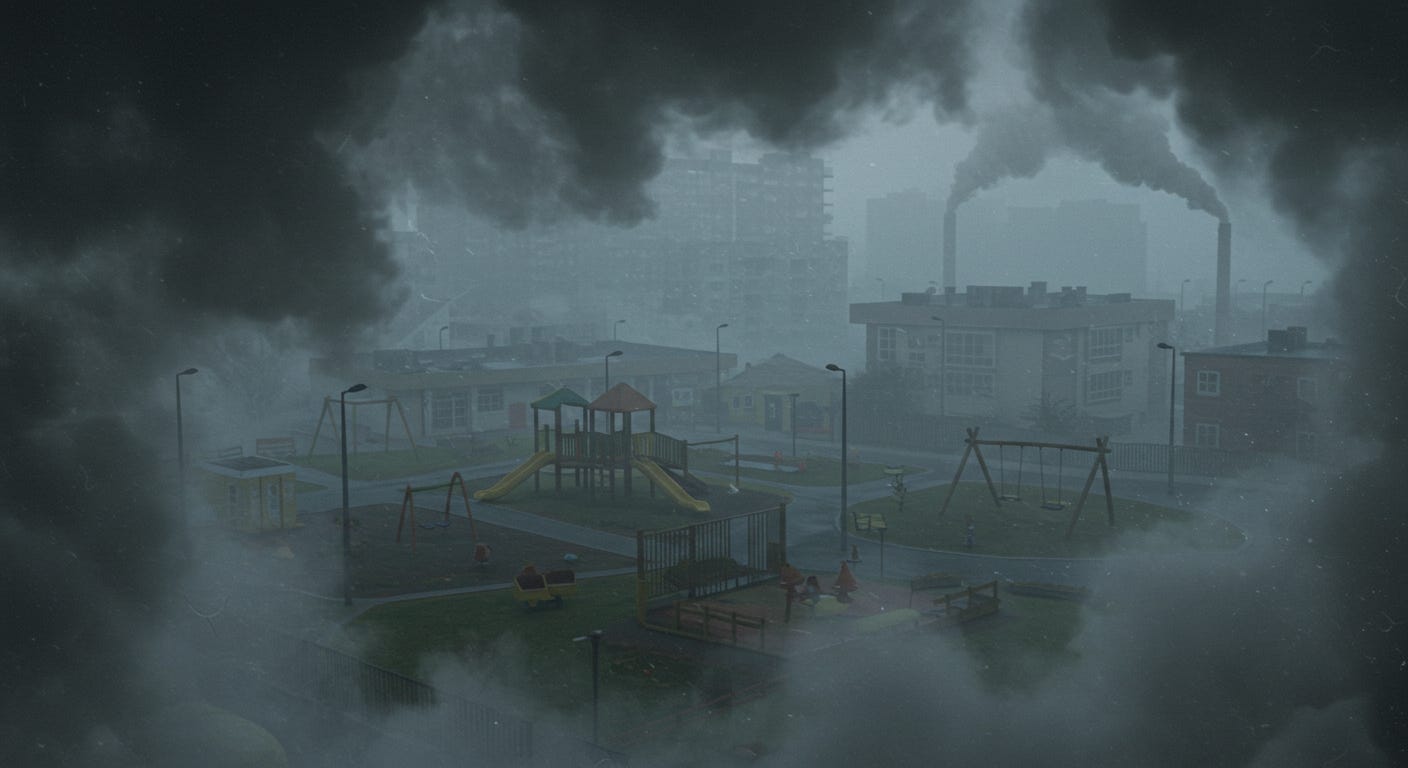
This phrase has embedded itself with the weight of dogma in public health campaigns, institutional declarations, and headlines demanding urgency. Parents, lawmakers, and social organizations repeat it with the anxiety of those who believe they are saving their youth from an invisible enemy. But what if the real neurotoxin doesn’t reside in the vape your child carries in their backpack, but instead floats—unpunished and unnoticed—in the air we all breathe?
From New York to São Paulo, passing through Brussels or Bangkok, the narrative is nearly unanimous: Young people must be protected from electronic cigarettes. And that is true—but only up to a point.
Flavor bans are multiplying, leaving former smokers with no choice but to give up the pleasant liquids that once offered them an alternative. Punitive taxes are imposed, high enough to drive many back to tobacco. School campaigns are expanding, but they often educate not through knowledge but fear—through a pedagogy of panic. Vaping has become a symbol of moral decay, an emblem of a lost generation.
And yet, amid this moral crusade, a recent and rigorous study by the Barcelona Institute for Global Health (ISGlobal) reveals something even more disturbing: the genuine risk to children's brains may not come from nicotine, but from the toxic air they inhale from the cradle.
The Ignored Evidence: Air Pollution and Neurodevelopment
Published in Environment International in February 2025, the study was led by a high-level international team based at the Barcelona Institute for Global Health (ISGlobal) with academic ties to leading institutions across Europe and the United States. Among the authors are Michelle Kusters, Laura Granés, Sami Petricola, Henning Tiemeier, Ryan Muetzel, and Mònica Guxens—researchers whose careers span epidemiology, child psychiatry, neuroimaging, and public health.
Their institutional affiliations—which include Universitat Pompeu Fabra, Erasmus University Medical Centre in Rotterdam, the Carlos III Health Institute, Bellvitge University Hospital, the Harvard T.H. Chan School of Public Health, and the Catalan Institution for Research and Advanced Studies (ICREA)—attest not only to the methodological rigor of the study, but also to the global and transdisciplinary scope of the concern around the neurotoxic impact of air pollution.
Indeed, the ISGlobal study stands among the most comprehensive to date on the relationship between atmospheric pollution and brain development. Using functional neuroimaging on over 3,600 children between 9 and 17 in Rotterdam, the researchers identified significant alterations in neural networks involved in emotion, attention, language, and abstract thinking.
Early exposure to air pollutants—specifically PM2.5 and PM10, which are microscopic particles suspended in the air from vehicles, industrial emissions, and combustion—during the first three years of life, a critical stage for brain formation, showed significant effects: a reduction in connectivity between the amygdala—a brain region that regulates emotions and stress—and key areas such as the auditory cortex and the ventral attention network, both of which are essential for processing language, focusing attention, and developing abstract cognition.
What is most alarming is that these dysfunctions are not fleeting. They persist through adolescence and may shape learning abilities, emotional regulation, and mental health across the lifespan.
But this is not only an environmental threat. It is also a class issue. The highest levels of exposure are found in neighborhoods with limited access to green spaces, poor infrastructure, and constant traffic. There—where asphalt burns and the air weighs heavy—cognitive gaps widen, and educational opportunities shrink even before children learn to read.
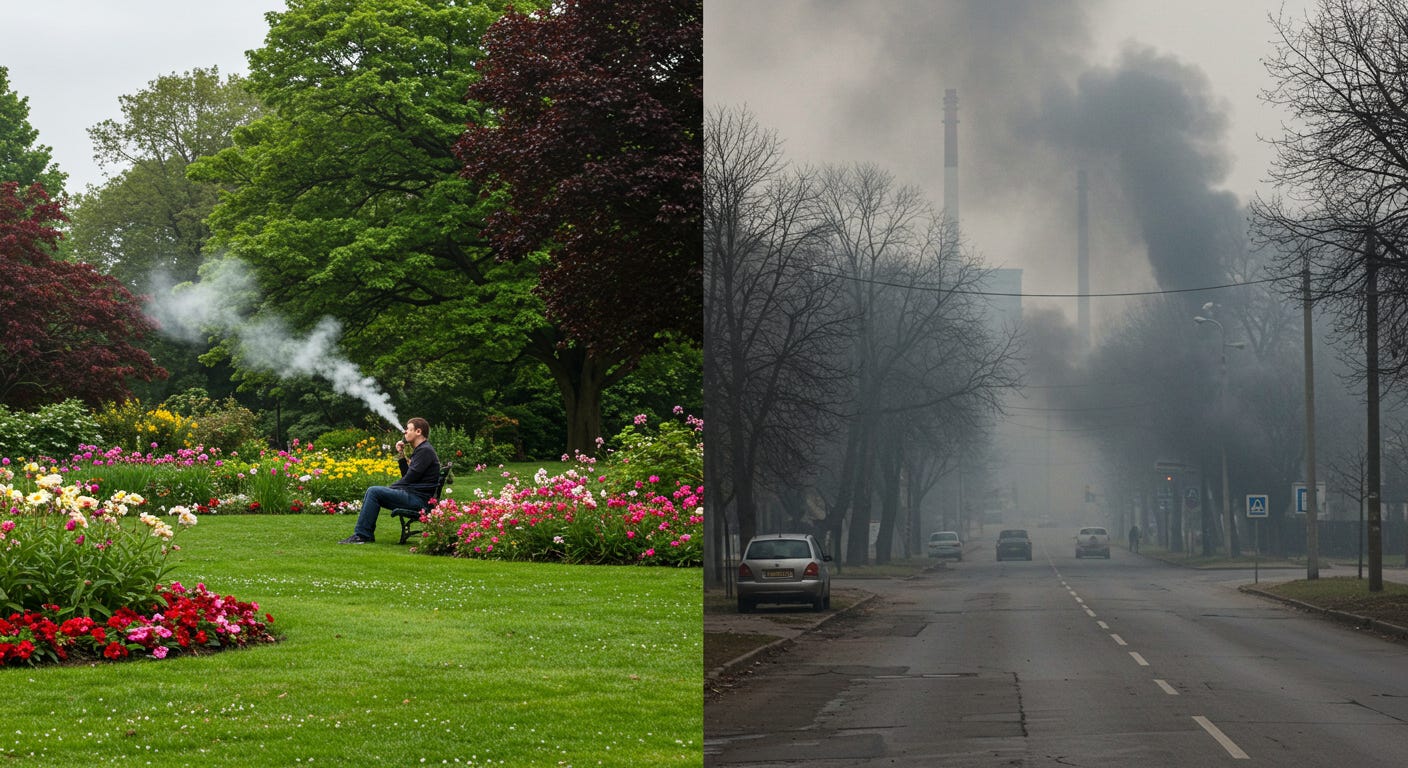
Unlike vaping, this finding sparked no scandal, no press conferences, no school campaigns. There were no alarming headlines. Only a thick silence—like the very air that sickens us.
In contrast, multiple rigorous investigations into electronic cigarettes have found that the aerosol produced by vapes contains significantly lower levels of toxic compounds compared to the smoke of combustible tobacco. Recent toxicological evaluations support this conclusion, showing marked reductions in the presence of carbonyls, heavy metals, and fine particles in e-cigarettes compared to traditional cigarettes, which have circulated through our lives for more than a century.
Dr. Roberto Sussman, a physicist at the National Autonomous University of Mexico, emphasizes that “what matters is that these toxic substances [in e-cigarettes] are present in doses small enough not to cause harm.”
And yet, beyond the chemical composition of the aerosol, what sets vaping apart from other environmental risks is the absence of solid clinical evidence linking it to structural or functional changes in the human brain.
In contrast to urban air pollution—whose neurotoxic effects have been clearly demonstrated through functional neuroimaging and longitudinal cohort studies—there is currently no robust clinical proof that regular use of vaporizers, whether by adolescents or adults, alters brain structure or function.
As Professor Peter Hajek explains, “if smoking does not reduce IQ—and longitudinal studies show it does not—then it is unlikely that nicotine, in the absence of combustion, would have that effect.”
Who Breathes Which Air, and Who Is Regulated by What Morality?
Why this disparity in treatment? Why is adolescent vaping—an individual, visible, and symbolically disruptive behavior, subject to educational intervention—condemned so vehemently, while the massive and daily exposure to neurotoxic air is tolerated without alarm?
The answer lies not in toxicology but in moral (and economic) politics.
As anthropologist Mary Douglas once explained, modern societies do not define danger by its objective impact but by what unsettles their sense of order. The “impure” is whatever doesn’t fit, whatever disturbs the symbolic map of what is deemed acceptable.
Within that framework, nicotine—associated with youth, pleasure, and informality—is perfectly suited to occupy the role of symbolic contaminant, an ideal scapegoat.
Air pollution, by contrast, is its opposite: structural, diffuse, invisible, anonymous. It has no face, no disruptive aesthetic. No one flaunts it. No one vapes it. It seeps silently through the folds of urban infrastructure.
And so, while electronic cigarettes become prime targets of campaigns and prohibitions, the air we breathe remains beyond scandal—even though its effects have been documented for decades with overwhelming scientific evidence. Invisibilized not by ignorance, but by convenience.
Fetishes of Risk and Structural Blindness
This moral management of danger has been extensively analyzed by sociologist Ulrich Beck. In his theory of the “risk society,” Beck warns that contemporary threats—diffuse, elusive, without a concrete location—escape the traditional mechanisms of political action.
What cannot be seen, touched, or clearly named does not provoke alarm. It generates no reaction. It dissolves into routine.
That is why, while vapes—visible, personal, unsettling—are demonized, the emissions of millions of cars each day become background noise. Urban wallpaper. Toxic normality.
The result is what Beck would call a “risk fetish”: a substance is singled out, stripped from its context, and turned into a social fear totem. Nicotine occupies that place today. It is assigned inherently harmful properties—often without regard for dosage, method of use, or social context—while systemic threats with overwhelming evidence remain hidden from view.
Thus, the focus of control shifts: no longer on polluting structures, but on young bodies. Especially those from working-class neighborhoods. What is visible is punished. What sustains the order is tolerated. The symptom is fought. The cause is preserved.
What If We've Already Lost the Brain Development We're Trying to Protect?
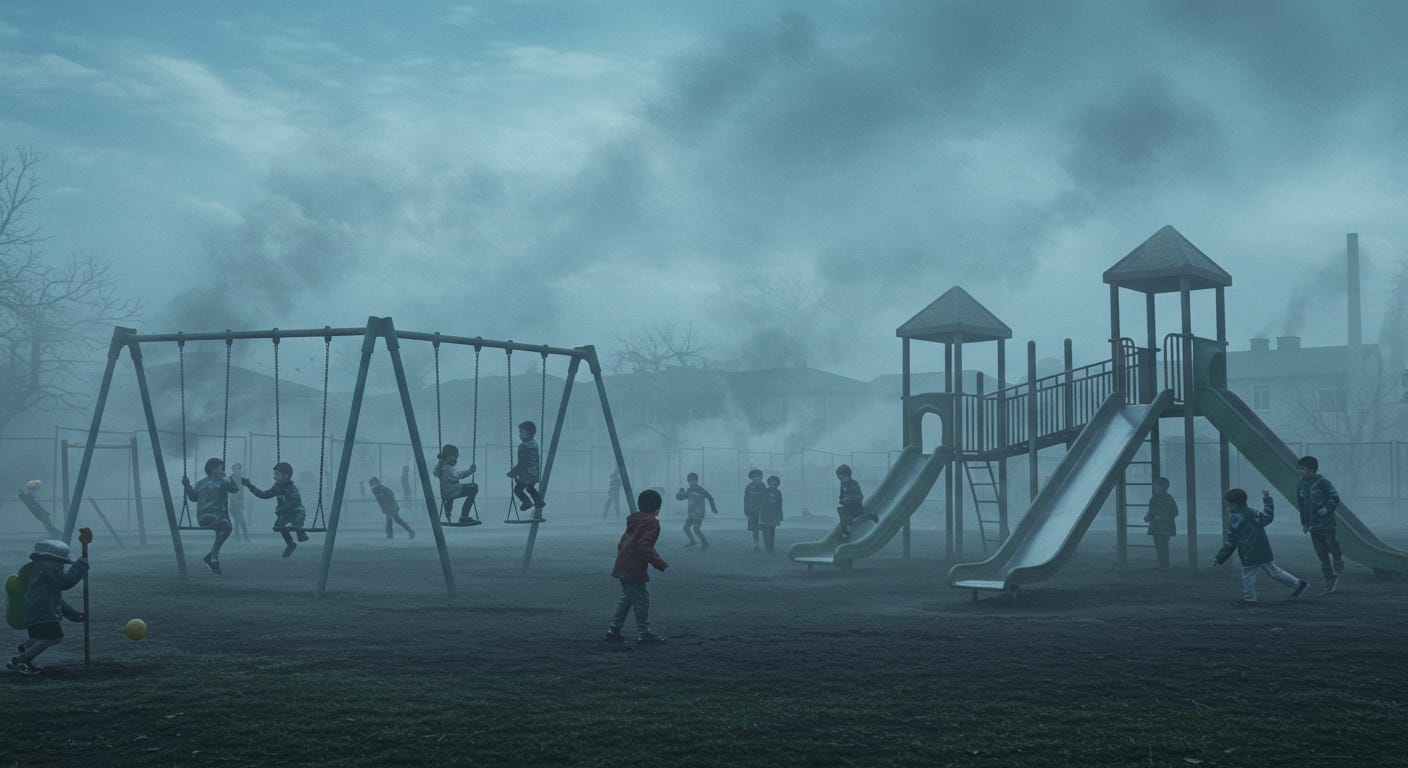
The ISGlobal study is not a prediction. It is a diagnosis. The brain alterations caused by pollution are not on the horizon—they are already here. They have affected entire generations for decades. They are visible in brain scans. They persist into adolescence. And they are closely tied to public transportation, urban planning, and environmental justice policies.
Meanwhile, the discourse around vaping rests on fragile evidence. As noted by Professor Peter Hajek, a smoking cessation expert at Queen Mary University of London, there is no solid evidence in humans showing that nicotine, on its own, impairs brain development. The studies that claim so are based on animal models using extreme doses or on correlations confounded by uncontrolled social variables.
“If smoking doesn’t reduce IQ—and the evidence shows it doesn’t—then it’s unlikely that isolated nicotine would have that effect,” Hajek explains.
By contrast, airborne particles have been altering the connections between the amygdala and the cerebral cortex for decades. Not as a hypothesis, but as empirical certainty. Not as fear, but as fact.
Irony, Oxygen, and Environmental Justice
In the face of this public health dissonance, irony is not mockery—it is a form of clarity.
“Vaping banned in schools… but tailpipes are welcome.”
“We protect your brains… while you breathe arsenic.”
Both could serve as unintended slogans of current public policy. What has form, color, and aesthetics is punished. Teenagers with vapes are feared because they disrupt the choreography of order. But the urban planning that condemns them, day after day, to inhale lead, cadmium, and ground-level ozone goes unchallenged.
This is not about idealizing vaping. It is about restoring a sense of proportion. And with it, the forgotten principle of health justice.
Studies like that of Balfour et al. (2021), published in the American Journal of Public Health, remind us that while not harmless, vaping is substantially less damaging than combustible tobacco and can serve as an effective harm-reduction tool for adult smokers. Denying this possibility for ideological reasons—or out of fear of scandal—is to condemn millions to the continued grip of smoke, all in the name of a moral crusade against nicotine.
And meanwhile, we go on breathing poisons. No headlines. No alarms. No redemption.
What If Protecting Children’s Brains Means Changing the Air, Not Just Habits?
Public health doesn’t need more punitive crusades—it needs policies rooted in environmental justice.
Fewer cultural fetishes. More evidence.
Fewer fear-driven headlines. More urban planning.
Fewer campaigns against vapes. More regulation of the true sources of massive neurodamage.
Perhaps nicotine is not the great threat to 21st-century brain health.
Perhaps the real danger—the deepest, the most ignored—is institutional blindness.
The inability to look up,
where it floats—silent, invisible, persistent—
the true poison.
The one no one regulates because it has already become part of the air.
Questions (Still) No One Wants to Ask
Why does public discourse prioritize controlling nicotine over cleaning up urban air—when the latter has far stronger and more extensive evidence of its impact on children’s brain development?
To what extent does the moral panic around nicotine reflect a need for social control more than a genuine medical concern?
What does it say about our society that we normalize toxic urban environments yet turn vapers into symbols of youthful decline?
Kusters, M. S. W., Granés, L., Petricola, S., Tiemeier, H., Muetzel, R. L., & Guxens, M. (2025). Exposure to residential air pollution and the development of functional connectivity of brain networks throughout adolescence. Environment International, 196, 109245.
Note
This is not a neutral text, nor a linear one, nor a comfortable one. Its form is also its argument. Fragmentation is not a stylistic choice but a crack. Irony is not ornament, but scalpel. Unanswered questions are not a lack of rigor but a method of disruption.
This oscillation between scientific evidence and cultural critique responds to an urgency: to shake entrenched certainties, to break the syntax of hegemonic health discourse, to dismantle the hierarchies that determine what dares to be called “risk.”
Because if we continue thinking within the same structures that once legitimized pollution as a mere backdrop, we will never see the poison floating above our heads.
This text does not aim to reaffirm what is already known, but to interrupt it. It does not seek to close with answers, but to open cracks through which air might enter. Because perhaps the first step toward a truly just public health is not to regulate bodies, but to unsettle imaginaries.