The Time Between Cigarettes
What smoking reveals about a society where the future has lost its weight, and why a public-health culture of guilt, purity, and abstinence reaches its limits among the most vulnerable.
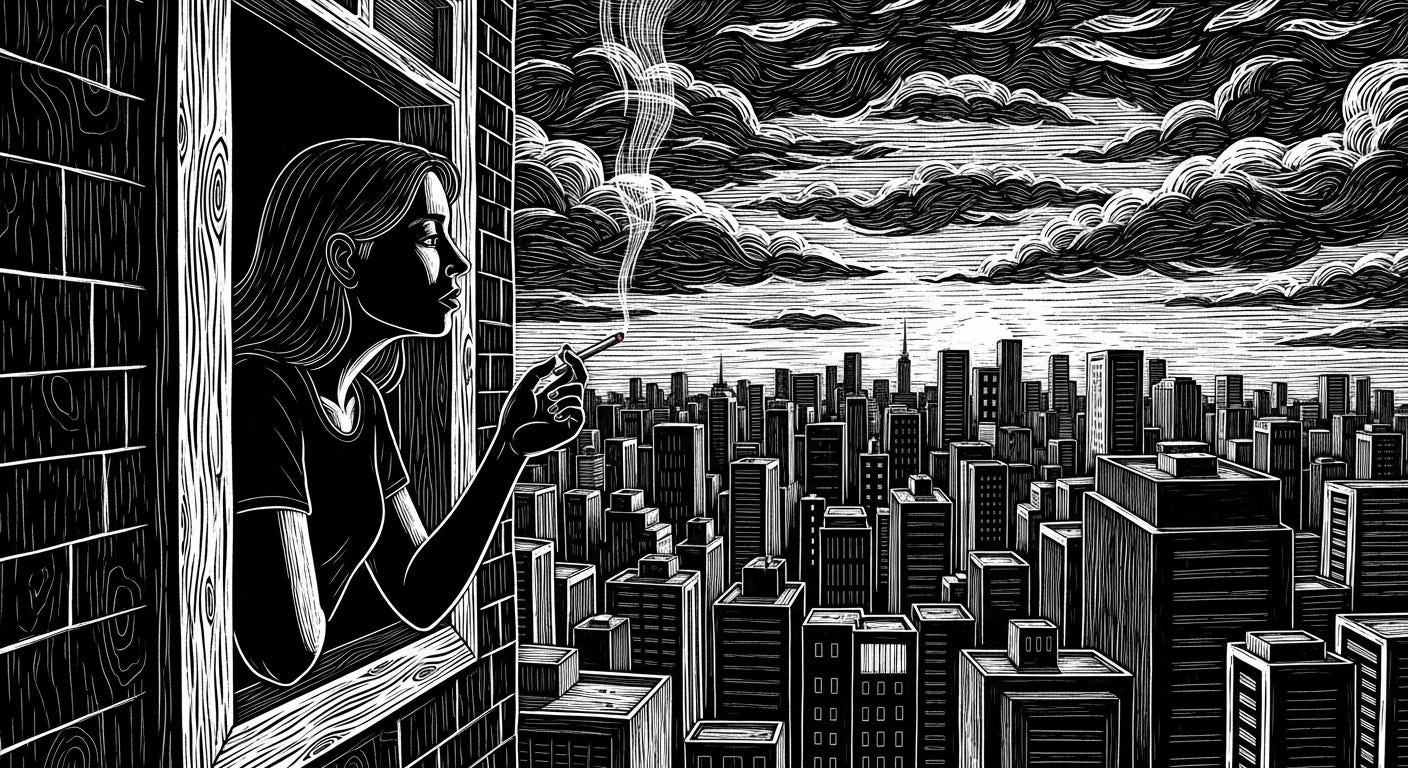
She counts the coins twice.
The first time is the gesture of someone who already knows the outcome.
The second is for someone who still hopes, against all evidence, that the numbers might have changed.
They haven’t.
The lighter fails twice; on the third, the flame comes up unsteady.
She lifts a leaflet from the health clinic as a shield.
On it, a darkened lung wavers in the wind.
“I keep borrowing from the future,” she says, to no one.
“I never know when it comes due.”
The sentence isn’t a metaphor; it’s a household budget.
Anna, twenty-eight, in a supermarket uniform, lives in the gap between what comes in and what runs out.
Here, the cigarette is not the abstract vice of anti-smoking campaigns. It is a small technology of survival: it structures waiting, marks a pause, holds open the distance between one bus and the next.
For decades, public health spoke in the language of the future: stop now to live later, defer pleasure in the name of a reward still to come.
Prevention rested on a quiet premise: that tomorrow was a credible horizon, something worth investing in.
But for millions, the future has lost weight; the horizon has shortened.
Between precarious work, fatigue, instability, and urgency, life is no longer organized around the promise of improvement, but around the management of the day.
It is on this terrain that prevention begins to lose its grip, not because people have become more ignorant or irresponsible, but because the logic of postponement requires a pact not everyone can enter into. When the present fills with exhaustion, fear, and improvisation, the long term no longer governs behavior with the same force.
The bus arrives. The doors open.
Anna steps on, drops in her coin, and moves toward the back.
The future is the interval between this cigarette and the next.
In a yellow-lit kitchen, an old fan turns without cooling the air.
August, seventy-three, shirt open at the chest, coughs over the sink; an old cough, one that already knows the way.
On the table, a full ashtray and a cup of cold coffee. On the refrigerator, a child’s drawing held by a magnet: a crooked sun, a house, three stick figures.
August picks up a pack. He begins the motion of lighting and stops. He looks at the drawing. He places the cigarettes in a glass jar, one by one, unhurried, as if storing something dangerous. Then he sets the jar on top of the cabinet, out of a child’s reach. His hand comes down slowly.
The scene belongs to the past, but it still pulses in the present. August is Anna’s grandfather. The interrupted gesture, the almost-lit cigarette, the jar lifted out of reach, condense something larger than an individual decision. The will was there. What was missing was ground.
For much of the twentieth century, the promise of progress was also a promise of time: present sacrifice would yield returns later on. To a large extent, collective life was organized around the idea that the future was worth the investment.
That arrangement has worn down in recent decades. Not all at once, but through erosion: successive crises, persistent precarity, accumulated distrust. Historians have called this narrowing of temporal experience presentism. Outside theory, though, the phenomenon is easy to recognize. When work is unstable, housing is uncertain, and rest is scarce, the long-term loses density. Planning ceases to be a habit and becomes a wager.
In Brazil, this contraction of the horizon is also distributed across territory and class. In São Paulo, the gap in average life expectancy between districts exceeds twenty years. It is as if two countries occupied the same space: one in which tomorrow stretches far enough to justify sacrifice, another in which it collapses from within. Smoking does not produce this divide, but it settles inside it.
The waiting room is a limbo of plastic and cold light.
An electronic display flickers numbers that don’t move.
On the wall, a blackened lung.
Next to it, a faded slogan:
“SUFFER NOW TO LIVE BETTER LATER.”
Someone coughs. Someone checks their phone. Anna holds a handful of coins inside her bag, as if she could protect them.
The doctor doesn’t look up from the chart.
“How long have you been smoking?”
Anna opens her mouth. “Since—”
She doesn’t finish. The doctor has already checked a box: training, neutrality. He slides a leaflet across the table, illustrated lungs, benefits, and a phone number.
Anna takes the paper with both hands, like someone receiving a promise she isn’t sure she can keep. She signs where she’s told. She doesn’t read.
For decades, public health has proposed the same bargain: give something up now — a pleasure, an immediate relief — in exchange for benefits later. Eat better, move more, quit smoking, adhere to treatment.
The exchange feels fair when the future is a livable horizon, when tomorrow still inspires trust. But prevention is not only a calculation of risk; it is also a moral contract, and that contract presumes stability. Above all, it presumes that delay is worth it.
In the waiting room, that contract already appears worn.
Anna signs without reading — not out of carelessness, but because the gesture of compliance has, for many, become an empty ritual, a formality that life quickly contradicts. Here, prevention fails not because of ignorance. It fails because it requires a kind of material and subjective ground that not everyone has.
There is a mismatch between the temporality of prevention and that of precarious life. The first operates in the long term: years without smoking, disciplined routines, benefits accumulated quietly. The second in the short: the money that runs out at the end of the month, the exhausted body that demands relief now, the urgency that does not wait.
As the public-health literature shows, quitting smoking is strongly associated with income, education, mental health, and access to support. Not because low-income smokers know less or want less, but because cessation is not simply an act of will. It requires time, care, margin, and protection against extreme stress, resources that are deeply unevenly distributed. On its own, will does not carry a person across a compressed present.
At the factory gate, the sky hangs low and dirty.
Damian, forty-two, his uniform stitched at the chest, wears a stopped watch on his wrist. He looks at it not to tell the time, but to confirm there is no time left.
The lighter fails twice; on the third, the flame comes up unsteady.
He cups his hand around it, shielding the fire from the wind.
The first drag is short, almost tentative. He coughs once, dry, then swallows it, glancing sideways, as if coughing were a minor fault.
Later, in another kitchen, another night. Anna is in sweatpants, her hair fallen loose with exhaustion. She washes a pan quickly, trying not to make a noise. She opens the window just enough to slip her arm through. The flame wavers, then catches. She inhales and holds the smoke for a second. It is not a pleasure. It is a suspension.
From the bedroom comes the sound of a child breathing.
In the hallway, a toy on the floor.
She almost trips. Stops. Looks.
Love, irritation, fatigue, all at once.
She exhales the smoke outward, trying to make it disappear before it can exist inside.
In both gestures — Damian at the factory gate, Anna at the window — the cigarette appears not as an abstract habit, but as a small everyday technology. It does not resolve suffering; it gives it shape. It marks an interval, introduces a ritual, and offers a brief, predictable reward in a day without contour. In lives where work, sleep, time, and care have lost their regularity, it functions as a minimal tool of self-regulation.
What appears irrational from a public-health standpoint becomes legible when one looks at what the cigarette provides in return. It is cheap, portable, and immediate. It requires no appointment, no line, no consultation, no free time. It is at hand. And for that reason, it often takes the place of other forms of relief and care that, for many, are expensive, scarce, or simply unavailable.
But its function is not only chemical.
The cigarette also organizes time: it marks the beginning and end of a pause.
In fragmented routines, irregular shifts, and schedules that disregard sleep, the minimal ceremony of lighting it opens an interval that still belongs to the smoker, however brief, however paid for with their own health.
In unequal contexts, smoking is more heavily concentrated among those pushed into precarious paths of income and schooling.
This difference does not stem only from unequal knowledge; it also reflects how rest, pleasure, and care are socially distributed.
In conditions of greater vulnerability, the cigarette takes the place of forms of listening, relief, and protection that are scarce, inaccessible, or simply nonexistent.
There is also a relational dimension.
The cigarette accompanies waiting, solitude, and the exhaustion of alienated work. It becomes a pretext to step out of a stifling room, a license for a minute away from children, bosses, and the demands that do not cease. For those who spend the day caring for others — children, the elderly, clients, patients — or converting their own time into income for others, it can become the only gesture that still feels like it belongs to their own body, even as it exacts a destructive cost.
On the ground, a faded yellow rectangle.
Inside it, a man lights a cigarette.
Clara approaches with grocery bags. She slows. Looks at the blue sign:
“SMOKING AREA.”
Looks at the rectangle.
She makes a small detour, as if the ground there were contaminated.
As she passes, she holds her breath for half a second.
Adjusts her coat with her fingertips.
Two steps later, she exhales. Her face does not register relief. It simply confirms.
In the elevator, the man steps in right after her. Clara presses the button for her floor. Without looking, she also presses the fan. The light comes on. A young woman pulls her backpack to her chest, like a shield. Someone shifts back an inch. No one speaks.
Later, in the building’s group chat, Clara writes: “Hi everyone, smoke has been coming up into my apartment. There are children and elderly people here. Please be considerate.” The reactions arrive within seconds: hearts, thumbs up, an “exactly.”
Clara is not a villain. She is someone who has internalized the moral language of public health as an almost natural extension of good manners.
In her gestures — the detour, the held breath, the press of the fan — there is no explicit cruelty. There is a boundary being drawn.
The smoker no longer appears as a subject with a history, a routine, an exhaustion. He becomes odor, nuisance, a failure of care.
Anti-smoking policy has produced real gains. The decline in smoking in Brazil, for example, is one of them. But part of its public language has remained tied to a moralizing imagination, in which the smoker appears as a deviation, a failure of will, and irresponsibility.
The social structure of suffering recedes from view; individual behavior takes over the entire stage. The result is the predominance of a pedagogy of shame.
This pedagogy does more than communicate risk; it teaches the smoker to feel out of place. The yellow rectangle on the ground, meant simply to contain harm, also marks an exception: one may remain there, so long as one remains apart.
The smoker’s body becomes a suspect body, polluting, displaced.
The phrase on the waiting-room wall — “SUFFER NOW TO LIVE BETTER LATER” — condenses this imperative. To suffer in the present appears as virtue; to refuse that suffering, as weakness. The problem is not informing people about harm, but turning the difficulty of quitting into a failure of character, as if smoking were merely an individual choice, rather than a socially produced condition, often shaped by exhaustion, precarity, and inequality.
There is also an economic dimension to this arrangement. Tobacco is heavily taxed, and the burden falls more heavily on those with less. The state regulates, collects, and warns; care, however, does not reach with the same breadth. For many, the equation looks like this: smoke, pay dearly, fall ill, carry the blame.
The effect of this combination — stigma, regressive taxation, uneven support — is the individualization of suffering. Not smoking ceases to be only a matter of health and becomes a marker of discipline, self-control, and belonging. What is at stake, then, is not only care. It is also status, distinction.
The nurse peels back the seal on the package.
The plastic snaps.
Anna sits with her hands in her lap; short nails, a pen mark on her finger.
She pulls up her sleeve without ceremony.
Cotton on the arm.
A dry touch.
The nurse applies the patch and smooths it with two fingers, counting silently. Anna watches the gesture: the way something is sealed that wants to come loose.
Days later, in the middle of the night, she is alone in the kitchen.
On the table, the box of patches and the crumpled leaflet. She pulls up her sleeve. The old patch is still there, one edge lifting. She removes it slowly.
The skin beneath holds the mark: a pale rectangle at the center of her arm.
She opens another. The plastic snaps softly. Applies it. Smooths it with two fingers. Presses the edge until it holds. Pulls her sleeve back down.
She stands there for a moment, as if waiting for her body to agree.
Later, at the bus stop, she takes a cigarette from the pack. Stops.
Her arm hangs suspended.
She puts the cigarette back.
From her bag, she takes a dark object, worn from use. She brings it to her mouth. A short pull. A small light flickers on and off.
The vapor dissolves into the cold air.
What these scenes show is not the redemptive victory of abstinence. It is something else: a movement of substitution, hesitant and imperfect, but guided by a logic that traditional public health takes too long to recognize. When someone cannot, or does not manage to stop immediately, care cannot simply withdraw.
Not everyone will interrupt harmful practices in the short term, and the conditions for doing so are unevenly distributed. Faced with that, the response is not to abandon those who continue to use, but to reorganize care around what is possible: to reduce risk, to lessen suffering, to widen the margin for breathing.
This is the moral turn of harm reduction. It replaces the question “how do we make someone stop?” with another, more modest and more concrete: “how do we make it so that, while they do not stop, they are harmed less?” It is not surrender. It is a refusal of the all-or-nothing logic. Care no longer demands purity in order to begin.
In the case of tobacco, this includes intermediate strategies: nicotine-replacement therapies, gradual reduction, and, for many, a shift to non-combustible forms of use. None of this eliminates risk. But for smokers who have repeatedly failed in attempts at complete cessation, these alternatives may mean less harm than continuing to smoke conventional cigarettes.
Resistance to this approach is not only technical. Part of it rests on some legitimate concerns: the long history of manipulation by the tobacco industry, uncertainty about the long-term effects of certain products, the risk of displacing, rather than dissolving, dependence, and the fear that intermediate strategies may reopen markets, normalize new forms of harm, or weaken decades of hard-won regulation.
But the resistance does not end there. It also arises from a moral discomfort with the idea that care might coexist with imperfection, with continued use, with bodies that do not purify themselves all at once.
Anna, at the bus stop, the vapor dissolving into the cold air, is not a success story by conventional standards. She still performs the gesture. She still depends on nicotine. But she no longer burns the clinic leaflet to light her cigarette. The change is ambiguous, negotiated, and still, it is the change that is possible.
In a well-kept garden bed, the leaves gleam with moisture.
A gardener, in thick gloves, trims the shrubs.
Snip. Snip.
Branches fall. Leaves fall.
He gathers everything with a shovel and pushes it into a black bag.
Two meters away, almost out of frame, a man sleeps wrapped in a thin blanket. From inside it comes a cough — small, persistent. The gardener does not look. He picks up the sprayer. Presses. The leaves take on a fresh shine. The man keeps coughing.
The scene is brief, but it condenses a question: What is the point of pruning dry leaves if the soil remains the same?
Harm reduction is an ethical and practical achievement. It allows care to continue where abstinence cannot begin. But it carries a risk: detached from structural transformation, it can become the humanized management of ruin.
The gardener tends to what is visible; what can be contained, trimmed, and made presentable. He does not alter the conditions that produce that body on the pavement. He does not alter the cold. He makes the garden appear habitable, while its actual inhabitant remains at the margins.
In health care, this logic reproduces itself easily. A patch, a brief consultation, an intermediate strategy — all of it is better than nothing. It reduces suffering, prevents greater harm, and widens the margin for survival. But if the social conditions that produce exhaustion, anxiety, and illness remain untouched, care risks being reduced to maintenance: it keeps the body functioning, however precariously, while leaving intact the ground that makes it ill.
The critique, then, is not of harm reduction but of what happens when it is stripped of its political dimension and returned to mere management. At that point, care ceases to be an opening and begins to function as containment: it intervenes on isolated bodies, manages symptoms, prolongs survival, but does not touch the world that distributes exhaustion, inequality, and illness. The collapse of the precarious is averted, without interrupting the order that produces it.
Anna, with the patch under her sleeve and the vapor dissolving into the cold air, has managed to exchange one technology for another. She has reduced the harm. But she remains at the same bus stop, with the same coins that don’t add up, the same faded uniform, the same endless waiting. The care she received has helped her not to worsen. It has not moved the world that keeps her there.
The bus sways.
Bodies lean together, in silence.
Anna rests her head against the fogged glass.
She wipes it with her sleeve, opening a small circle of visibility.
Outside, the street is coming into morning: people walking fast, a dog nosing through trash. In here, the silence of those already tired.
Anna’s hand goes to her arm by instinct.
She presses the patch, as if needing to confirm that it is still there.
Later, in the dark kitchen, she sits at the table.
The box of patches. The crumpled leaflet.
She pulls up her sleeve. The edge of the patch holds firm now. She smooths it once with her thumb. Opens the drawer. The crumpled pack is there.
She looks. Closes the drawer.
She rests her forehead against the cabinet for a second.
Breathes in through her nose. Lets the air out through her mouth, without a sound. Turns off the light.
There is no redemption in this scene: no heroic gesture, no solemn farewell.
Only a woman who looks at the pack and does not light it.
A hand that presses the patch, to feel that it is still holding.
The politics of the “still” is made of these minimal gestures. It promises no cure, demands no purity, expects no redemption. It works with what remains, insisting on doing something with that remainder.
Still alive. Still breathing. Still with some margin. Still capable of care.
It is a modest ethic, but not a minor one. In a time when the future has lost its density, it offers a form of care equal to exhausted lives: not the kind that abandons when someone fails, but the kind that remains, reduces harm, and sustains what is possible.
The politics of the “still” does not replace social justice. It does not make the coins add up, does not restore length to a horizon that has shortened. But it prevents the absence of social justice from becoming an alibi or a license for abandonment. While the ground does not change, it sustains those who are still standing on it.
Anna, in the dark kitchen, with the pack in the drawer and the patch on her arm, is not a success story. She is a case of persistence. And when the horizon contracts, persistence may be the only form of future that remains.
The bus moves on.
The glass fogs again.
Anna leans her head.
Her hand goes to her arm.
The patch is still there.