

The Second Day of the Conference That Wasn’t Supposed to Happen
Geneva, the diplomatic capital where silence is meticulously orchestrated with multinational accents and the timing of protocol, hosts almost as if hiding one of the most elegant stages for contemporary dissent.
The Hotel Royal, just minutes from the UN headquarters, could go unnoticed were it not for its beige stone façade, neoclassical columns feigning a noble past, and two potted palm trees symmetrically placed, not mere decoration but botanical sentinels, aligned like an official photograph.
For a moment, everything might seem improvised. But nothing is out of place.
The revolving door turns slowly, welcoming each body with the same antiseptic neutrality that seems to govern everything here, from discreet smiles to the carpet’s color palette.
Crossing it shifts more than air; it displaces time. Outside, honking horns, hurried footsteps, and overlapping languages crash into each other before vanishing. Inside, sound folds in on itself, as if the world had been sealed in plastic wrap.
In the lobby, everything feels restrained. Even the smiles follow an invisible choreography. The pale marble floor reflects light that trickles through tall windows, as though daylight were being carefully filtered. White flower arrangements sit silently, momentarily resembling unspoken promises, signed by anonymous hands. Ahead, the reception returns smiles with algorithmic precision. But to the left, as one begins to climb the stairs, the script starts to fray. The staging begins to falter.

There, the staircase unfolds with the quiet elegance of a space designed to impress without spectacle. The white marble reflects light with restraint. Wrought iron handrails, adorned with subtle gold accents, support the ceremonial gesture of ascent.
A thick red carpet, embroidered with barely perceptible arabesques, stitches each step together, guiding one’s pace with the confidence of someone who knows exactly where they’re headed, even if they won’t say it aloud.
At the top, a deliberately ornate silver-framed painting shows a seaside scene: wind-filled sails, anonymous fishermen, a sea vast enough to hold all destinies. It’s kitschy, no doubt, but deliberately so. It hangs there as a reminder that even the stiffest solemnity occasionally requires a detour into irony.
Climbing those steps these days isn’t just a matter of incline; it’s a crossing.
At the top, a modest and functional hallway leads to narrow corridors where silence gives way to articulated voices, microphones being tested, and shoes brushing against carpet.
Gradually, sound becomes listening. And what’s heard there is rare: people actually being heard.
The conference is held in an understated room of the Hotel Royal. And it truly feels suspended in time. Dark wood chairs upholstered in red-striped velvet are arranged with ceremonial discipline around round tables draped in white cloths, more like a traditional Swiss café from another century than a political-scientific conference room.
And perhaps that’s the point.
The lighting descends from ceiling-mounted spotlights, placed with theatrical precision, as if the setting demanded not just attention, but bearing witness. To the left of the entrance, a tripod with a professional camera sits motionless, like a documentary sentinel on silent alert.
“We’ve only just begun.”
David Williams’ voice carries across the room with the calm firmness of someone who speaks to be heard. And he knows that, here, people still listen. He quotes the Carpenters with pinpoint irony, not from nostalgia, but to underscore the absurdity of the moment. The song, once a vehicle for memory, now scores a collective decision: to resist.
There’s no romance; no longing for a lost past. Instead, a deliberate choice not to yield. The music doesn’t stir memory to comfort: it draws a line.
To resist the silence reigning just a few blocks away, in the sealed rooms rented by the World Health Organization. There, where protocol replaces dialogue; where consensus comes prepackaged, sealed in technical jargon, ready for approval. As if thinking were a threat. And debate, a delay.
“The other event is a place for monologues. This one, for conversation,” Williams states, with the calm of someone who knows the reach of his voice. His tone shifts between levity and gravity; he brushes humor with the promise of more musical references in the days ahead, but quickly returns to what brought him here: indignation.
He speaks of a COP that has shut its ears. That turns public health into a screen, not just to stifle science, but also dissent, the consumer, the counterpoint. “The Conference of the Parties,” he says, “isn’t willing to hear any party that challenges its narrative.”
Among the echoes of the previous day, one moment remains vivid: Dr. Tiki Pang's speech, former director at the WHO. Technical, but not cold. Precise, yet tinged with unmasked disillusionment. “It doesn’t matter whether the cat is black or white, as long as it catches mice,” he quoted, voice clear and rhythm measured. The room responded with a thick, reverent silence.
Inside that old, almost banal phrase hid a simple heresy: tobacco control should be pragmatic. Not ideological.
Williams recalls the respectful clash between Clive Bates and Roger Bate, two thinkers from opposing camps, but united by one essential principle: the right to disagree without being silenced. “They disagreed with the mic on. Eye to eye,” he remembers. “That doesn’t happen in the closed rooms of the official conference.”
But dissent isn’t just metaphors. Williams points to the case of Mexico, where prohibitionist policies pushed nicotine into the illicit market—and the market, into the hands of cartels.
“Heads in buckets,” he says, bluntly.
It’s not an image. It’s a diagnosis. A statement of fact, not a figure of speech. A portrait of public health dressed as moralistic policing, and failing.
The counterexample comes from Sweden, almost like a scene from another film. There, youth smoking has dropped below 2.3%, driven by culturally normalized use of snus, a less harmful, accessible, and accepted product.
It wasn’t a state campaign. It was a habit. It was a choice.
In Japan, the logic echoes: less combustion, fewer hospitalizations, less pressure on the healthcare system. “For someone who advocates for taxpayers, like me,” Williams says with a half-smile, “it’s hard to ignore that equation.”
And then he circles back. Good COP, he says, isn’t a celebration. It’s a restoration. A deliberate effort to reclaim space for what was silenced: doubt, science, and common sense.
“There, dissent is punished. Here, it’s a prerequisite.”
On the Other Side of the Wall
Seated, men and women held postures oscillating between skeptical vigilance of learning and reverent focus. Water bottles, glass cups, open notebooks, and a few crossed arms. It all composed a choreography of listening.
Now and then, when off the table, Martin Cullip, one of the event’s organizers, could be seen in the back. Leaning against a column, arms folded, standing as if weighing whether to join the debate or simply absorb it.
The atmosphere resembled a conclave: a space carefully detached from the institutional cacophony of the outside world. Inside, they spoke of science, politics, the body, and risk. But also, in some way, of silence.
Cullip steps onto the stage like someone delivering a war report. “We used to call it Bad COP. Maybe we should switch to Catastrophic COP.”
His voice blends reporting with weariness. Just hours into the plenary, any lingering hope had already vanished. Dr. Tedros, the WHO Director-General, had spoken twice. Same words. Same script.
“Ceremony, not science,” Cullip sums up.
The COP sounded less like a conference and more like the stage of a multilateral liturgy; everyone knew their lines by heart, and uncertainty had been deliberately erased.
Even outside, the Taxpayers Protection Alliance made it into the annals of the event, not as a participant, but as an enemy. Accused of “industry interference” for organizing the Good COP and advocating harm reduction.
“Who wrote that bulletin?” Cullip asks, already knowing the answer. The air hums with subtext.
He references David Zaruk's piece at Firebreak, a publication that tracks the COP’s hidden threads from the Campaign for Tobacco-Free Kids to Bath University, from ENSP to the Global Center for Good Governance in Tobacco Control, all orbiting the same financial sun: Michael Bloomberg.
“Bloomberg fights the industry with one hand… and raises his own with the other.”
The most surreal moment of the day, according to Cullip? The Dirty Ashtray Award. Winner: New Zealand.
Why? Cutting the number of smokers in half within five years and crediting harm reduction. A heresy, under the reigning doctrine.
On the flip side, Mexico took home the Orchid Award, even as cartels control much of the illicit nicotine trade.
“Heads in buckets,” Cullip repeats. “But the narrative was preserved. And that’s what matters to the WHO.”
The institutional dissonance is laid bare by the WHO’s own rankings. Sweden sits at 68th, despite having the lowest smoking rates on the planet. New Zealand dropped from 2nd to 61st.
The crime? Being effective through methods unsanctioned by dogma.
Other nations try to push back. Serbia dared to argue, in plenary, that public policy should be evidence-based. A solitary act of lucidity.
Australia, on the other hand, banned reduced-risk products and saw a violent illicit market emerge: 300 attacks on tobacconists. One death.
Yet it’s hailed as a model. It was being floated as the next COP host (to be held in Armenia).
Irony abounds. Memory, perhaps less so.
Cullip closes his speech with a line that betrays his British polish. “This isn’t harm reduction. It’s harm production,” Tedros said. “He lives on another planet.”
But bewilderment doesn’t lead to paralysis. The Good COP isn’t just an alternative; it’s what remains of institutional sanity.
A reminder that listening is a political act. And silence isn’t neutrality. It’s a choice.
A Stage Connected to the World
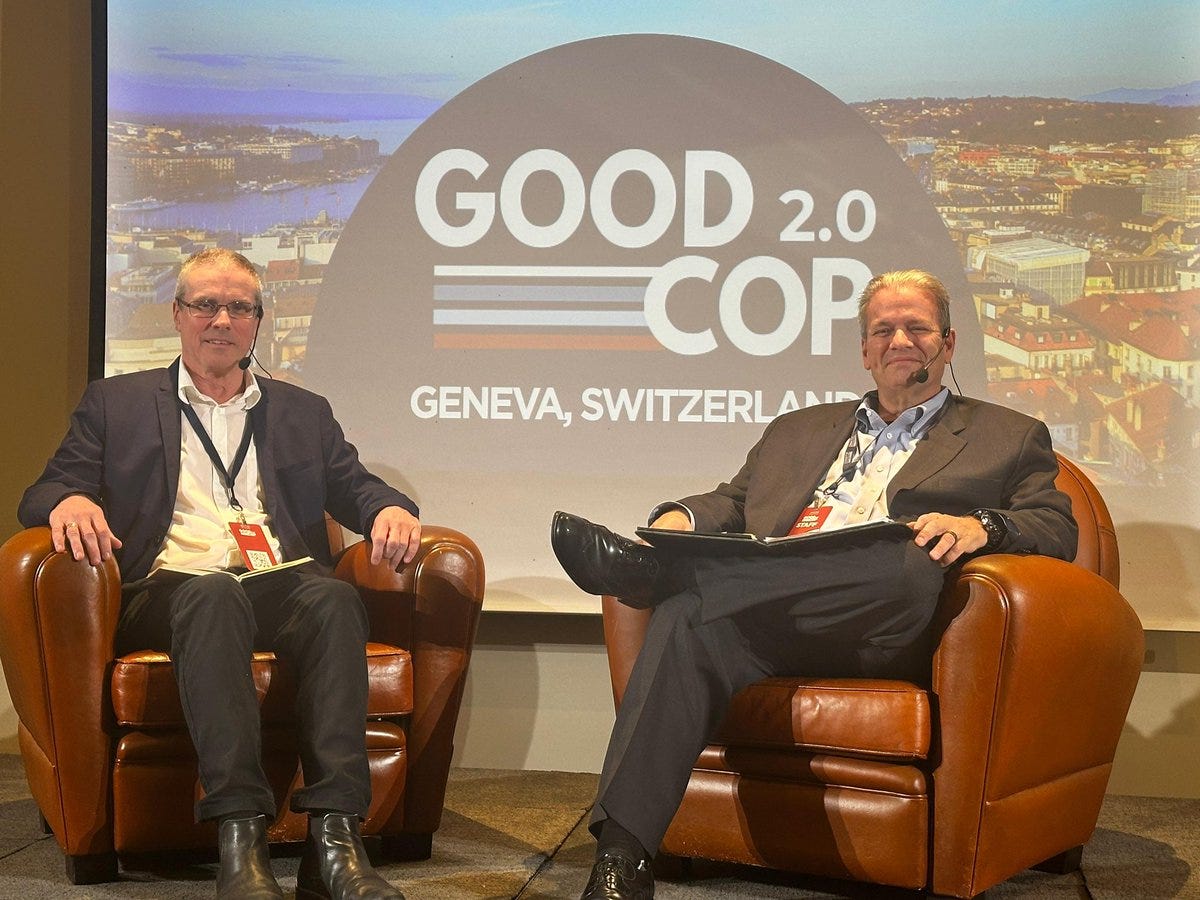
When it’s strong enough, the Geneva sun shines through the stained glass with an angled light. But only a few notice it. Williams and Cullip wrap up the morning’s introduction like they’re kicking off a resistance festival. Sessions in Spanish. Panels on science, paternalism, and funding. Videos from consumers, from ordinary voices with extraordinary stories.
“We need to speak to the whole world,” says Williams. “And here, the microphones are open.”
Attention turns to the Philippines and to Saint Kitts and Nevis. “I hope they hold the Panama line,” says Williams, recalling COP10. Cullip remembers: Denzel Douglas is a one-man delegation, but a man who’s already shown courage.
There’s time for a story. At COP6 in Moscow, after a photo leak, the WHO decided to cut Wi-Fi across the entire building. “Staff couldn’t even message their families.”
Williams smiles. “Here the signal’s strong. And we’re the only place livestreaming a conference about the conference.”
Cullip closes: “Over there, they speak to the converted. Here, we speak to the real world.”
The Ideology That Erodes Trust
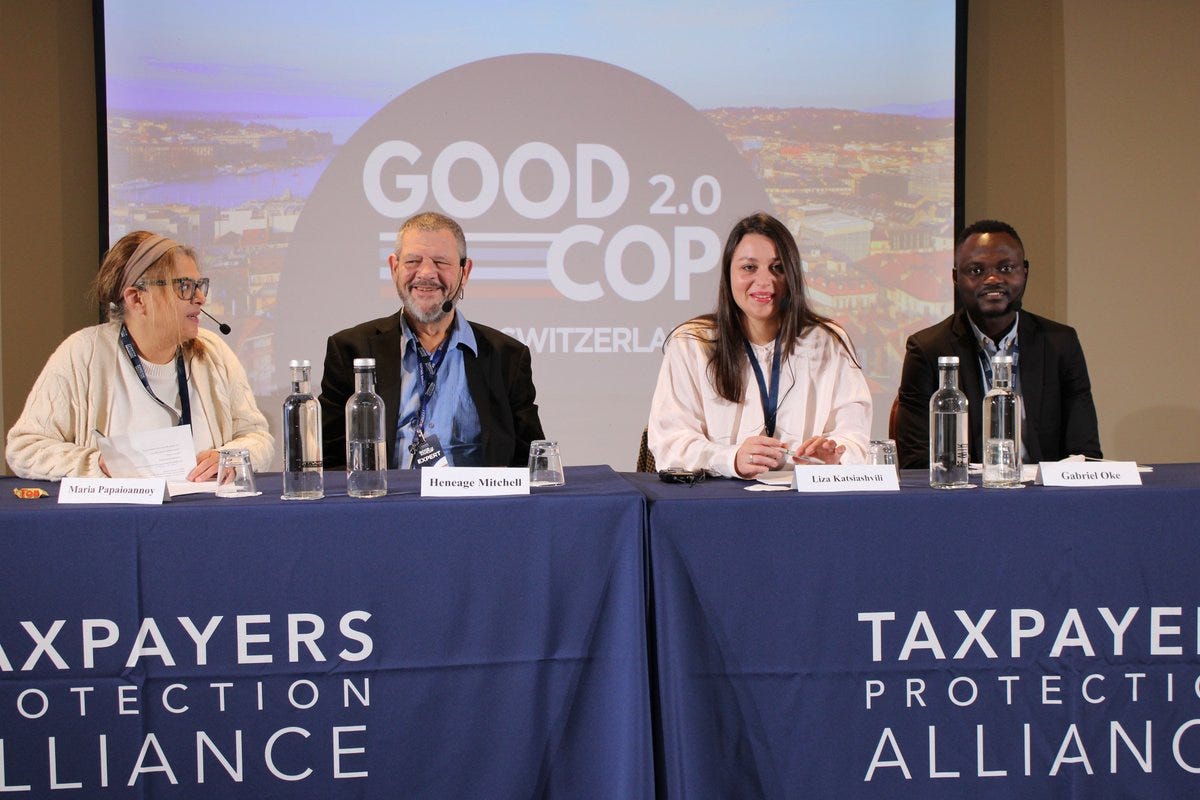
Around 11 a.m., Maria Papaioannoy-Duic steps onto the stage. The panel's title warns: A Dangerous Game: Is a Stubborn FCTC Ideology Eroding Trust in Public Health? She smiles, razor-sharp. “Obviously, the answer is yes.”
She introduces the panelists with the ease of someone who’s shared trenches with them.
Heneage Mitchell — “H” — a former smoker of 45 years and founder of Factasia. Switched to vaping in 2016; never looked back. “Give me a high five,” Maria jokes.
Liza Katsiashvili from the World Vapers’ Alliance. PPE from Oxford, field strategist, restless voice.
Gabriel Oke, from Nigeria. Biomedical scientist and communicator, founder of the THR Journal. One of Africa’s sharpest minds on harm reduction policy.
Maria doesn’t dodge the question. She goes straight to the point: Does the FCTC stand on science or ideology?
H answers with surgical precision. “It doesn’t.” The FCTC lies, ignores data, and excludes the very people it is meant to protect: consumers. “We’re 1.4 billion. And we’ve never been invited.”
Liza reinforces the point. Consumers are erased. The WHO’s own FAQ lumps cigarettes, vapes, and snus together, as if the risk were identical. “That’s not science. That’s catechism.”
Gabriel broadens the scope. He brings the pandemic into frame. “The WHO acts as if it’s infallible. But in a crisis, people don’t go to the WHO website. They go to TikTok.” Visibility remains. Legitimacy doesn’t.
Maria pauses for a teachable moment. “LMIC stands for low- and middle-income countries. And it’s okay if you didn’t know. I had to look it up, too.” The phrase becomes a mirror. Learning is a strength. But to the WHO, she suggests, error is weakness.
Gabriel resumes. African nations are beginning to ask if it’s time to think for themselves. “If the WHO isn’t delivering what it promised, why does it still exclude us?”
Liza returns to the mic. She speaks about Georgia. High smoking rates. No harm reduction. Plenty of stigma. “I live this. In my body. And when I look at institutions, I see disdain.”
Maria mentions Canada. In Nunavut, 70% of the Indigenous population smokes. Cigarettes cost $30. Flavors are banned. Alternatives? None.
Toward the end, Maria asks the inevitable question. What happens when public health becomes an ideological tool?
H doesn’t flinch. Gray markets. Cynicism. Risk. In Thailand, half the parliament vapes. But everyday citizens are criminalized.
Gabriel recounts a recent meeting in Nigeria. They were debating how to regulate nicotine pouches. The FCTC? Utter silence. “If they won’t answer, we’ll look elsewhere.”
Liza closes with steel-trap logic. “If prohibition worked, India wouldn’t have 100 million smokers. If bans solved things, Brazil wouldn’t have seen its first increase in a decade.”
Maria ends with clarity.
“We’re not asking for privilege. We’re asking for respect. We’re not asking for dogma. We’re asking for science. We’re asking for humanity. And that should never be controversial.”
Applause. No Wi-Fi cut. No censorship. Just voices.
After the break, Geneva’s light returns, filtered through stained glass. A few can notice. An oblique, almost ceremonial glow, tilting, as if to listen.
The room regathers, but it isn’t the same. Now, Spanish is spoken. Not for diplomatic aesthetics, but for survival.
The language enters as if pushed by urgency. It disrupts the script. Breaks the formal liturgy of negotiations.
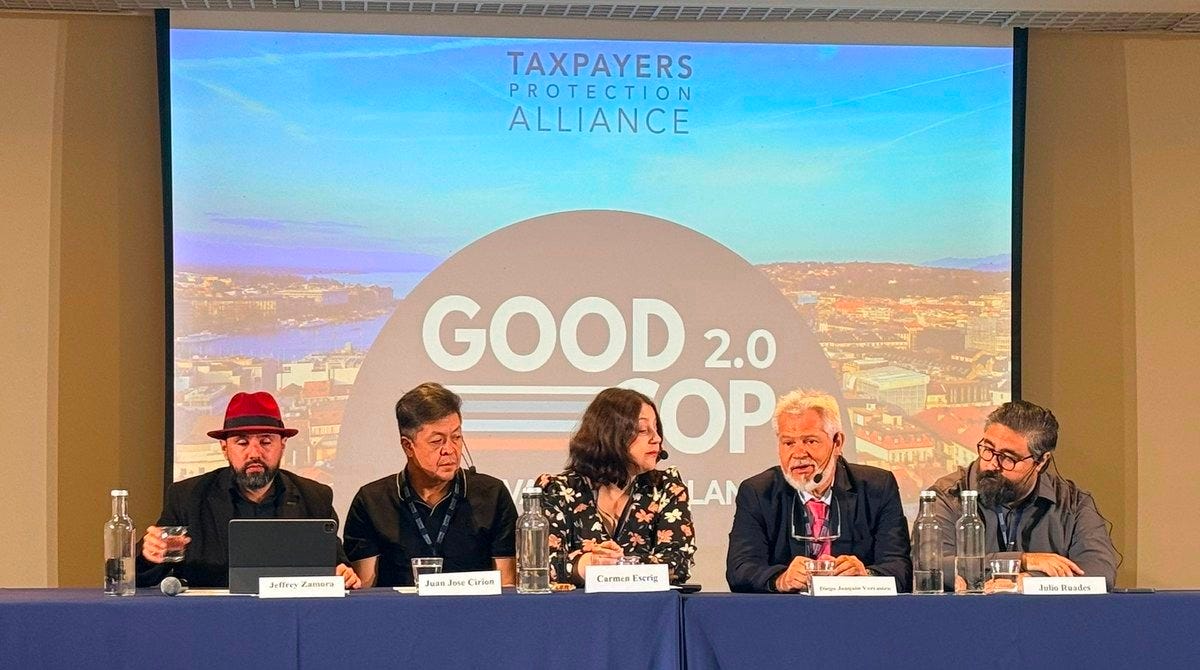
Jeffrey Zamora, from Costa Rica, opens with the gravity of someone who doesn’t just speak, but warns. “We’re going to talk about the most serious threats COP11 poses to harm reduction.”
It’s not an opening line. It’s an alarm.
Then come Hispanic voices—Argentina, Mexico, Spain—forming a multi-voiced testimony. A narrative that is, at once, a chronicle, a denunciation, and an autopsy of a public policy kept alive by machines.
An institutional body that breathes. But does not respond.
Verrastro: The Theater of Prohibition in the Global South
Diego Verrastro, an Argentine physician, speaks with the exhausted clarity of someone who knows the script by heart, yet refuses to normalize it.
“COP11 brings no new ideas. Only insistence.”
The sentence lands like a clinical diagnosis of a diseased repetition.
According to him, the only real innovation is the meticulous refinement of prohibitionism, a regression dressed up as progress.
In Argentina, since 2011, reduced-risk nicotine devices have been banned before even reaching the market. What was forbidden wasn’t what existed, but what could have. A ban on the possibility itself.
The result is a paradox as grotesque as it is functional: consumption is legal; purchasing is underground.
The user becomes, by design of the system, both citizen and offender.
“People are allowed to use, but forced to buy from traffickers.”
The line lands without emphasis, because it doesn’t need any. It is, in itself, a complete accusation: calm, irrefutable. The kind of sentence that doesn’t shout, but echoes like a silent verdict.
Verrastro draws on the history of medicine to trace a line from the criminalization of morphine to the censorship of anatomical studies. Ideologies, he says, have always arrived before evidence, and almost always to delay it.
Now, the target isn’t the substance. It’s the gesture. They want to outlaw the act of smoking, even without smoke. Even without nicotine. Even with a pen in your mouth.
“They’re not legislating substances. They’re legislating behavior.”
A new moralism, dressed as precaution, turns risk control into bodily domestication.
Ruades about Spain: The Tax Sparked Trafficking
Julio Ruades speaks with another kind of precision: numbers. His indignation is cold, almost technical, but no less searing. He presents data like open wounds in spreadsheet language.
In his country, it was the tax—not the substance—that birthed the black market.
In Spain, taxation on vape liquids triggered an immediate and perverse effect: vaping became more expensive than smoking. A reversal of public health logic that not only discourages harm reduction but also pushes consumers toward the parallel market, where prices are lower and risks are invisible.
“The same boats that used to cross the Strait of Gibraltar carrying hashish now bring in illegal vapes.” The route remains. Only the cargo has changed.
The equation, he says, is almost elementary. When you make the solution expensive and keep the problem cheap, the problem always wins.
It’s not a miscalculation. It’s a system that chooses where to squeeze and where to profit.
Without toxicological oversight, illegal products circulate with dangerously high nicotine levels. The State, in turn, loses on three fronts: revenue, regulation, and most of all, coherence.
Public policy, already wavering, now teeters toward collapse under the next offensive: a ban on flavors.
“If this goes forward, we’ll multiply the current problem a thousandfold. Legality will be wiped out by decree.”
It won’t be the end of nicotine. It will be the end of policy.
Carmen and the Reward for Failure
Dr. Carmen Escrig, also from Spain, doesn’t back down or soften her words. Her focus isn’t on side effects; it goes straight to the core of the issue: the institutional machinery that rewards failure and silences evidence.
She shines a spotlight where others look away.
She denounces a World Health Organization that has ceased to be a compass and has become a springboard, a stage for choreographed speeches by outgoing health ministers, not to save lives, but to save their careers.
In this theater, science gives way to obedience.
“This is how awards are won. Not for science. For submission.”
The medal comes when evidence bends.
Carmen reveals that Spain’s Ministry of Health is already preparing a flavor ban. And it does so fully aware of the consequences: the collapse of the sector, the calculated push of consumers toward the illegal market, and the risk of repeating a crisis like the U.S. EVALI outbreak; only this time, with nicotine instead of THC.
What’s most alarming, she says, isn’t the policy to come but the way current failure is camouflaged.
Spain’s smoking reduction statistics have been doctored. Data from migrant populations, historically low in tobacco use, were folded in to fabricate a national success.
“The WHO sees the charts. Gives awards. Politicians pose. And failure gets sealed with a medal.”
In the end, what’s being celebrated isn’t effective policy. It’s well-packaged fiction.
Cirion about Mexico: Between Decree and Delusion
It is in Mexico that the scenario reaches its most dystopian point.
Professor Juan José Cirion reconstructs, with near-forensic precision, the institutional theater that has stood since 2010: a prohibition built not on scientific evidence, but on presidential decrees, legislative gray zones, and personal vanity disguised as public policy.
The trigger? A domestic episode, almost anecdotal if not tragic. Then-president Andrés Manuel López Obrador caught his own son vaping. The next day, on live TV, before the nation, he signed a prohibition decree. He was applauded. Days later, honored by PAHO.
The final irony is as obvious as it is brutal. The former president’s son—the very reason for the decree—still vapes. Now, in football stadiums, in full view, while the state continues legislating against everyone else’s behavior.
“They’re pushing teens toward traffickers who don’t just sell nicotine. They sell the full package: drugs, violence, death.”
This isn’t hyperbole. It’s anamnesis. The diagnosis of someone who watches, day after day, the clinical effect of institutional hypocrisy.
Global Farce, Local Consequences
As the panel progresses, the voices converge, and the narrative becomes clear: public health has been hijacked. Not by evidence, but by interests. By bureaucracies chasing prestige. By governments turning regulation into spectacle. By a WHO that, having lost its bond with science, has also lost touch with reality.
The countries may differ. The diagnosis does not. Prohibition doesn’t reduce harm; it just changes its ZIP code.
But there’s a crack. And it doesn’t open by institutional concession. It opens through the recognition between voices that found each other here.
These are voices that carry not political theory, but the collapse of politics in their own bodies. Voices no longer asking to be heard out of courtesy, but out of urgency. Like drug users who know abandonment from within. Like people living with HIV, still negotiating their right to exist with capital barons. Like communities drowning not just in climate emergencies but in the way of life that manufactures disaster.
At the end of the panel, Carmen asks a question that no one answers. Not out of fear, but because everyone already knows the answer.
How do these officials sleep at night?
“I couldn’t,” she says. “They’re killing people. If they can’t save lives, they should make way for those who can.”
In the silence that follows, before the next session begins, one raw, difficult feeling lingers: In times of lies with name badges, telling the truth has become an act of resistance.
And sometimes, the last one.
The Last Line of Defense
Shortly after 3:30 in the afternoon, with the Alps shrouded in a mist that seemed intent on hiding more than just the landscape, a group of scientists gathered at the parallel conference that was never meant to exist, but persists nonetheless.
Outside, the rhythm was calm. Inside, a battle of meaning was underway.
What was at stake wasn’t just control over the scientific narrative around harm reduction. Something deeper was being contested: the right to ask uncomfortable questions.
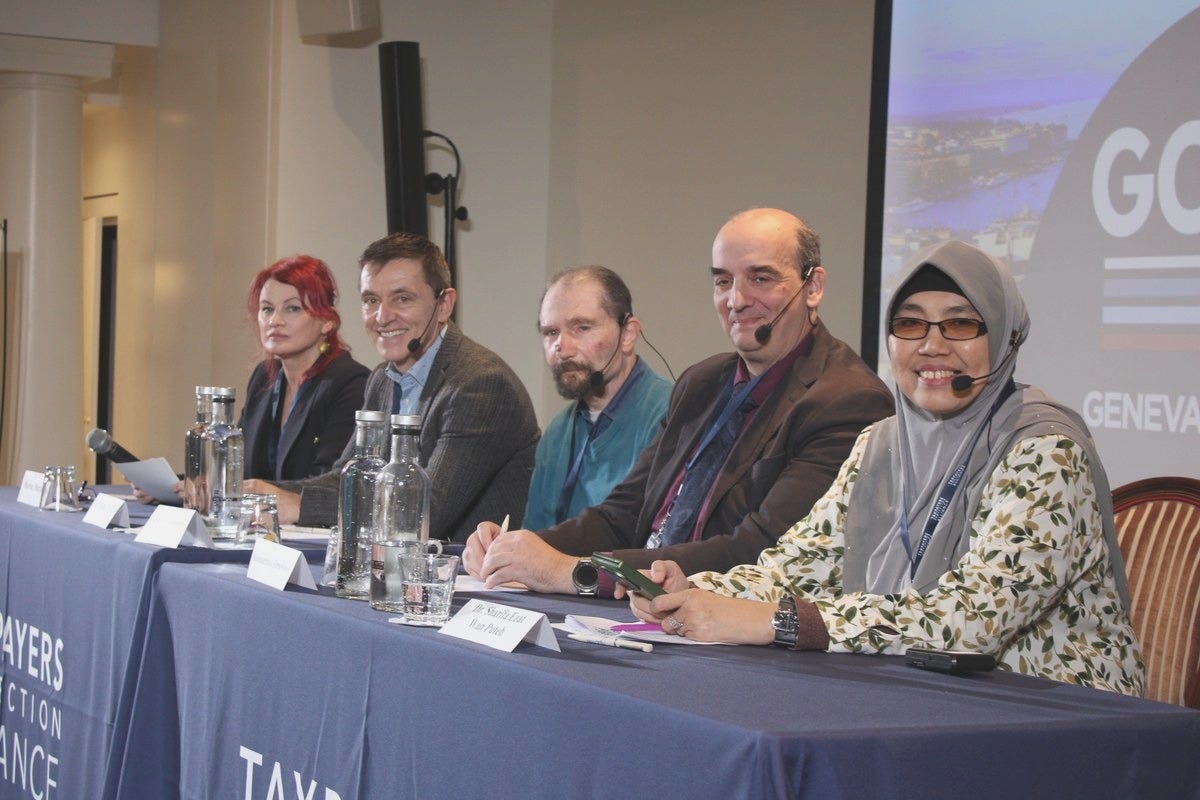
Dr. Marina Murphy, an Irish scientist with a precise command of words, opened the session with a question that sliced through the room: “Is the WHO and the Framework Convention still operating within the bounds of science, or have they already crossed over into something else?”
The provocation was not gratuitous. In front of her sat some of the world’s most respected experts in public health, toxicology, epidemiology, and aerosol physics. All critics of the WHO’s zero-nicotine stance.
All are convinced that the growing body of evidence around less harmful alternatives, such as e-cigarettes, heated tobacco, or nicotine pouches, is being systematically ignored. Or worse, punished.
The first to speak was Dr. Mark Tyndall, a Canadian physician, infectious disease specialist, and former director of the British Columbia Centre for Disease Control. Tyndall built his career on the margins of traditional medicine, working with marginalized populations during the HIV epidemic. Today, he applies those same principles to the smoking epidemic.
“When we started HIV prevention, the obstacles were moral, not scientific. We knew condoms worked. But the question was: why not just stop having sex?”
Now they ask: why not just stop smoking?
For Tyndall, abstinence-based reasoning ignores both human behavior and the structural inequalities that prevent millions from quitting cigarettes.
“The issue isn’t whether harm reduction products are 50% or 95% safer. The issue is: why do we care more about ideological purity than saving lives?”
When Dr. Roberto Sussman, a nuclear physicist at the National Autonomous University of Mexico, took the microphone, the tone shifted. With calm, firm diction, he delivered a technical explanation of aerosols—the vehicle by which nicotine is delivered to the body in combustion-free devices.
“People confuse vapor with smoke. But the aerosol produced by an e-cigarette or heated tobacco is fundamentally different from that of combustion.”
Sussman explained that without combustion, the generation of toxic compounds drops dramatically. He reviewed 48 studies claiming to find high levels of metals in vapes and refuted them one by one, highlighting serious methodological flaws. “Saying vapor is as dangerous as cigarette smoke is like saying the Earth is flat. It’s pseudoscience. It’s denialism.”
He ended with a sentence that lingered in the air: “Zero risk doesn’t exist. Science compares risks. It doesn’t eliminate them.”
Dr. Konstantinos Farsalinos, a Greek cardiologist and epidemiologist, spoke next with a calm but sharp tone. He reminded the audience that they were in Geneva, Switzerland—the country that pioneered harm reduction policies for heroin users in the 1980s, including the world’s first supervised injection rooms.
“Back then, they handed out clean syringes. Today, they refuse to offer safer alternatives to smokers. Where did the compassion go?”
Farsalinos cited a hard-to-ignore figure: over a billion people still smoke. Eight million die each year from smoking-related diseases. Yet public health policies seem to have learned nothing from the past.
“Debating whether these products reduce harm is like debating whether seatbelts work. That’s no longer a hypothesis. It’s a fact. The debate shouldn’t be whether they work—it should be how to regulate them responsibly.”
He denounced how science has been overshadowed by a toxic mix of ideology, political passions, and institutional orthodoxy. “Dogma disguises itself as caution. But inaction also kills,” he said.
When Dr. Sharifa Ezat Wan Puteh, from Malaysia, was invited to speak, she didn’t mince words. “A nicotine-free world is a fantasy. Nicotine has been with us for millennia. And it’s not going anywhere.”
Her public health work in Southeast Asia exposed her to the effects of prohibitionist policies: black markets, adulterated liquids, uninformed consumers, illegal products laced with synthetic cannabinoids or even veterinary anesthetics.
“The government blames vaping. But the problem is a lack of regulation. We can’t leave a vacuum and then act shocked by who fills it.”
Sharifa also criticized the poor quality of many studies surrounding harm reduction. “Some claim vapes cause asthma, but don’t even specify which liquids they tested. Is that science?” Then she asked, ironically: “We follow the British in almost everything. Why not this?”
Murphy resumed moderation to highlight what she considers a dangerous maneuver: the attempt to redefine key terms like “smoking,” “combustion,” and even “cessation.”
“When you manipulate language, you manipulate policy. If you call everything ‘smoking’—even when there’s no smoke—you end up legislating gestures, not risks.”
Farsalinos jumped in immediately: “That’s not science. That’s institutional propaganda.”
Sussman agreed. “When they claim heated tobacco causes combustion, they should specify at what temperature. But they don’t. It’s intentional confusion.”
The audience, mostly academics, activists, and consumers, remained silent. Not from passivity, but deep focus.
Toward the end of the session, the critique shifted from language and politics to the very scientific system underpinning regulatory decisions. Dr. Mark Tyndall, drawing on decades of experience in harm reduction during the HIV crisis, was blunt:
“The science of tobacco harm reduction is 30 years behind. And it’s because it’s been dominated by researchers who built their careers fighting cigarettes. Asking them to now accept a safer alternative is like asking them to erase their own biographies.”
He condemned the lack of long-term clinical trials, editorial resistance to dissenting studies, and the near-total absence of open debate.
“We now know many studies linking e-cigarettes to youth smoking initiation were flawed. But no one retracts. No one corrects. Where is the scientific accountability?”
Dr. Farsalinos added that most studies demonizing lower-risk products are published in journals with poor methodological standards, and are then amplified by the media and politicians looking to confirm their biases.
Dr. Sussman went further: “It’s easy to publish pseudoscience when it serves the dominant narrative. It’s hard to publish real science when it contradicts it. That’s not a technical problem. That’s an ethical one.”
When Marina Murphy took the mic once more to close the panel, she didn’t offer a conventional summary. She issued something closer to a declaration of principles: “The problem isn’t a lack of evidence. The problem is that no one wants to hear it.”
She reminded the room that the original purpose of scientific forums was to make space for informed dissent, constructive criticism, and the refinement of hypotheses. But that, she said, “no longer happens within the global public health system.”
Applause followed, measured but weighty. It wasn’t a celebration. It was recognition. Not a closing act, but a call to persist.
Outside the auditorium, as twilight fell and stained glass windows cast a soft glow into the hallway, several attendees stopped to talk. Not about the past, but about what’s next: a future where science, to survive, may need to relocate. Seek new spaces. Break old pacts.
In a side room, far from official decisions, a different version of the story had been written. One that, perhaps in the future, will seem obvious. One in which listening mattered more than commanding. And in which truth, however uncomfortable, remained a form of hope.
* * *
By the end of the “The Battle Over Science” session, the room, saturated with indignation and scientific clarity, didn’t dissolve into dispersion. It transformed into urgent continuity.
Good COP 2.0 carried on with the panel “People v. Paternalism”, where voices like British commentator Christopher Snowdon and Greek advocate Maria Papaioannoy discussed how consumer groups can (and must) challenge anti–harm reduction narratives, often bankrolled by large foundations and repeated uncritically by public authorities.
Next came the panel “Consumers Showcase”, hosted by Jeffrey Zamora, Jeannie Cameron, David Williams, and Juan José Cirion, which gave the floor directly to citizens.
Messages from Costa Rica, Mexico, the United Kingdom, and other countries addressed the FCTC Secretariat and the delegations present at COP11, with a clear plea: public policies that listen not just to data but to people. Policies guided not by punitive moralism, but by evidence and compassion.
The full program for the day, every speech, every denunciation, every moment of silence, is available on the Taxpayers Protection Alliance channel on YouTube.