The Purity Regime: Shielding
(2/3): Behind closed doors, the glossary becomes a wall. What cannot be said, cannot be heard — and what cannot be heard, does not exist.
Liturgy gives way to architecture: names, titles, clauses, glossaries — the regime’s most concrete, and most opaque, face. This is the institutional shielding of the Convention: a protection design that turns vocabulary into a barrier, disagreement into a threat, and participation into a risk. Dissent is not confronted. It is neutralized in advance.
Rigid on the Outside, Elastic Within
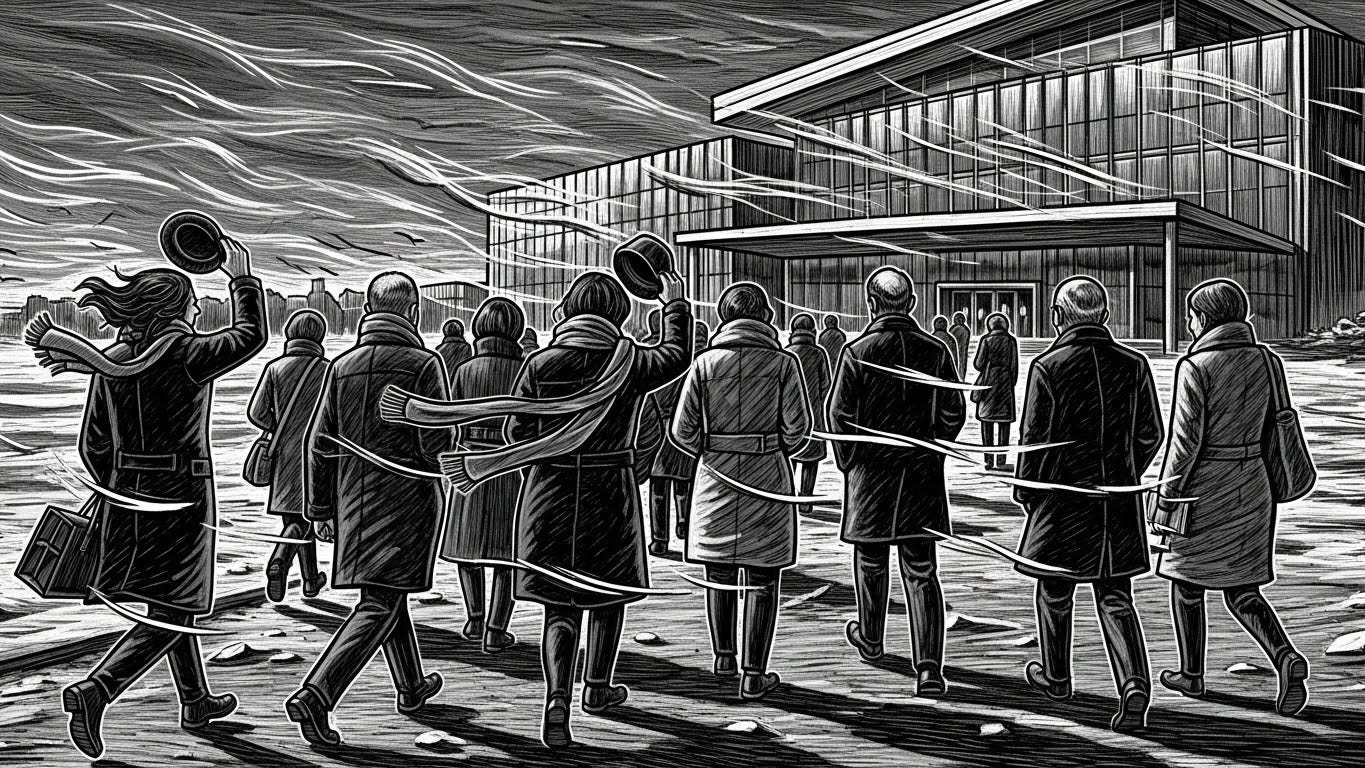
On the way to the central station, I review notes and photos in the dim glow of my phone. The bus is nearly empty, overheated against the cold outside.
The window rattles with every seam in the asphalt. Public vehicle silence: a muffled cough, a coat brushing against vinyl, warm air rising from the floor. And the engine, doing its job without asking for consent.
The building hosting COP11 is, formally, just a temporary seat of deliberation.
Temporary.
But in practice, it functions as a command center: from there, layers of language flow downward from screen to life. And it’s been a long time since this was only about “tobacco control” in the narrow sense.
The Framework Convention on Tobacco Control was conceived in the early 2000s, in a world where the industry still funded lawmakers, seduced physicians, and cultivated scientific doubt as a survival strategy. Doubt as a product. It methodically delayed the recognition of a truth already brought to light by the Royal College of Physicians in the 1960s: cigarettes kill.
The founding goal seemed almost obvious, nearly irrefutable: to shield public health policy from the interference of a sector too powerful to ignore.
Two decades later, the world around the Convention has grown more complex. Much of the industry now recognizes itself and seeks to rebrand to transform its portfolio in order to survive.
So does the treaty: rigid on the outside, elastic within. It no longer confines itself to raising taxes, enforcing smoke-free environments, or banning advertising. It now operates as a technocratic corporation within a growing regulatory ecosystem that comprises thematic committees, expert groups, technical missions, implementation reports, and peer-review mechanisms.
Every two years, COP adds another layer: “voluntary” guidelines, “enhancing” recommendations, decisions that, without altering a single line of the foundational text, quietly extend its scope of action, infiltrating domains from agriculture to e-waste management.
And yet, in the corridor, on the sidewalk outside the discreet side exit, none of it carries the solemnity of the page. Consensus comes with fatigue. With eyes that avoid the camera. With closed sessions. With people trained to say nothing.
I think about this as I recall the delegate who crossed my path at the side exit: eyes dried out from hours under white lights.
He lowered his voice to say he was forbidden to speak to the press. He didn’t say by whom. He didn’t have to. The prohibition was already there, in the way he quickened his pace, and in the way the sentence emerged: not as a warning, but as an apology.
Autumn as Protocol
In Geneva, power rarely enters through the front door. It enters through the agenda. And outside, the city’s own history tells that story, without asking permission.
In the same way, I return: no badge, no invitation, no clearance.
Arrival at the Centre International de Conférences Genève carries the neutrality of a place trained to host the world: concrete, glass, a canopy far too wide for any spontaneous gesture. The flags don’t decorate. They mark jurisdiction.
The recent rain leaves the asphalt with an archival sheen: a surface that already feels read, stamped, returned to its place.
On the façade, the building’s name stretches with the serenity of an institution that has watched a thousand urgencies come and go. COP11 appears as a hanging logo, a timestamped sticker affixed to an architecture that promises permanence.
The building does not celebrate. It authorizes.
Now that I walk the path in reverse, I notice: from the tram stop to the entrance, the world seems arranged not to raise its voice. Tracks. Clean sidewalks. Signposts. A normative blue indicating pedestrian priority; a pictogram of an adult and a child summarizing the pedagogy of obedience.
And just there, in the same neighborhood, the acronym UNHCR, in giant blue letters pinned to a low-curved building, a reminder that, in this part of town, human suffering is also managed through acronyms, protocols, committees.
The world becomes an acronym.
The body, a data point.
Another body, a case.
The beginning of winter, managed.
Fallen leaves — yellow, insistent — gather on the ground under the discipline of the wind, as if the city were storing autumn for administrative use.
The Agenda of Those Who Control Time
But the wound lies in the more minor detail, and for that reason, it governs. At the entrance, I didn’t find the metal ashtray overflowing with cigarette butts that once stood before a conference devoted to ending smoking worldwide. Edoxie Allier’s still life must have been swiftly removed.
The residue of habit in front of the emblem of the norm: crushed filters, damp paper, accumulated ash. Policy leaves clean pages. The body always leaves remains.
On the cold morning of November 22, 2025, under the diffused plenary light — cold and institutional — COP11 performed one of its most discreet and consequential rituals: the selection of who would operate the machine. There was no visible suspense. No raised voices. There was a procedure.
The choreography was brief, sanitized: headsets in place, thin-stem microphones angled toward trained mouths, laptops open like miniature control stations, paper cups crushed as if even water had to appear provisional.
In the background, a burgundy wall did the institution’s work: rigid, repetitive, making the human appear transient, the structure unmoved.
There, the door is not the door. It is the agenda.
From the outside, the conference sells itself as a diplomatic democracy: each country with its placard, its simultaneous translation, its minute to speak. Its surface.
The plenary offers equality as a set design. The real decision happens before and around.
The mechanism isn’t the microphone; it’s what decides who reaches the microphone. What makes it onto the agenda. When it arrives. In what textual form. At what point is the discussion “closed”. Which paragraph returns for revision, and which one dies for lack of time. And above all: What kind of disagreement the system is still willing to tolerate before it shuts down.
The Art of Making Things Exist
Formally, it is the Conference of the Parties that “rules.” Operationally, it gives itself a brain: the Bureau. The Bureau is no ceremonial ornament. It manages the agenda, allocates time, and decides when an item has been “sufficiently discussed” to become text, or to die of exhaustion.
At COP11, this mechanism was established in under an hour, through a one-page decision, dry, logistical, impeccable. It is there that power receives both name and title.
The elected President of the Bureau was Jawad Al Lawati (Oman). Vice-Presidents by region: Pedro Gullón (Spain), Hekali V. Zhimomi (India), Judith Segnon-Agueh (Benin), Derrick Heng Mok Kwee (Singapore), and Vera Luiza da Costa e Silva (Brazil). The same decision designates Vera Luiza, among the Vice-Presidents, as Rapporteur.
This is where many reports go wrong: they underestimate the least showy role. The Rapporteur doesn’t decorate the conference. They certify its memory. They organize. They frame. They consolidate.
In a multilateral body, whoever certifies the text also certifies the event: what enters as a “decision,” what becomes a “record,” what is relegated to a footnote, and what disappears without a sound.
If you control the flow, you control the outcome. Not only because you shape the evidence, but because, in a conference, the outcome rarely emerges from the strongest argument. It emerges from the surviving paragraph.
The Intact Machinery of Gavels
The second nucleus of power lies in the Committees. Here, the anatomy is unmasked. It’s in the committees that debate takes shape, sheds its excess, and becomes wording. Here, the gavel gets to work. And to work, in this case, is to choose what continues to exist.
At the start of the week, COP11 elected the chairs of Committees A and B. The decision was even shorter: half a page of names. On paper, an administrative gesture. In practice, the selection of who arbitrates what is “substantive,” what is “financial,” and what can be postponed without moral cost. Who controls time. Time doesn’t sign; it vetoes.
In Committee A — where the substantive and politically charged issues of the treaty are concentrated — the chair went to Damini Mohur (Mauritius), joined by vice-chairs Nuntavarn Vichit-Vadakan (Thailand) and Maya Roumani (Lebanon).
In Committee B — responsible for institutional architecture and budget nerve — the chair was assigned to Marcos Dotta (Uruguay), with vice-chairs David Yim (European Union) and Mary Ann Palermo-Maestral (Philippines).
The document formalizing these choices takes up just over a page. It registers no controversy. It contains no dissent. It reveals no fracture. It is the aesthetic of perfect governance: everything approved, everything “in order.”
But “in order,” here, describes the handwriting of the text, not the politics. It looks like bureaucracy. But it’s a mechanism.
The chair controls the microphone and the clock. Decides the order of interventions. The exact moment when “the room” has spoken enough. The instant a paragraph returns for adjustments, and the moment the agenda moves forward, pulling the undecided along with it.
That’s how disagreement becomes neutral language. How dissent is buried under fatigue and proceduralism.
Those familiar with the internal grammar of COP know: each name carries a cartography of precedents.
It’s not a conspiracy. It’s institutional sociology. A country-member does not arrive at the table as a neutral body. It arrives with moral victories, traumas, bureaucratic obsessions, alliances, and invisible borders. What changes is not just who holds the gavel, but what now counts as “reasonable,” “inadmissible,” or “out of scope.”
“It was well calculated,” a Latin American political actor told me under condition of anonymity, someone who closely followed the negotiations. “Mauritius, Thailand, Uruguay, European Union, Brazil… all are considered reliable for keeping the Convention cohesive.”
The word cohesive does the heavy lifting. In these settings, cohesion usually means: less noise. Less ambiguity. Less room for nuance. Sometimes, less dialogue. Sometimes, less agreement. The kind deemed unnecessary.
The real question is: what does cohesion cost? I ask whether this narrows the range of debate too much.
He hesitates, not for lack of opinion, but to calculate what he was about to say.
“That’s the price,” he replies.
And stops just before choosing a side for the sentence.
Protection, for some.
Closure, for others.
The Closed Glossary Method
From there, the rest follows. COP doesn’t need to say “no” out loud. It only needs to decide who organizes the “yes.”
And organizing the “yes” means designing the tutorial of permissible vocabulary: the phrases that pass, the terms that stick, the premises that no longer need to be debated.
Thailand enters Committee A with the authority of a full vape ban as an exportable showcase. A gesture that circulates well because it doesn’t need to prove effectiveness on the ground; it only needs to demonstrate firmness in the text.
Uruguay brings the prestige of having faced Philip Morris and won. A legal battle turned into a founding myth: heroic state versus predatory corporation.
The European Union arrives with the weight of its legal apparatus and a taste for standardization, a kind of power that doesn’t shout, but advances through drafting, through harmonization, through consistency.
And Brazil, with its historic stance of banning rather than regulating reduced-risk products, often plays the role of gatekeeper: any nuance risks being labeled a loophole.
Loophole is a police word.
All of this fits elegantly into the official lexicon: equitable participation, international cooperation, health promotion. But equity here is not distributed across the world; it’s distributed across language.
To enter the room, one must speak the right language. And more than speaking it, accept the premises that language carries and conceals. The regime operates through a filter of representation. It’s not just administrative exclusion. It’s a formal selection.
Whoever reaches the microphone has already been filtered. Listening, when it occurs, comes pre-edited. In practice, there is little to no space for smokers, users of reduced-risk products, frontline physicians, or scientists who do not share the orthodoxy of control. These groups appear as statistics and as threats. Rarely as subjects.
The result is a paradox: a global treaty that governs billions of bodies without consulting them. A regime that calls itself public health, and yet operates, simultaneously, as a system of belonging. Anyone outside the glossary becomes a risk.
“That made sense at one point. But now it’s become a historical flaw,” said the same delegate, still off the record. “The Convention was born in a context where the urgency was shielding public policy from industry interference.” He pauses, measuring the temperature of his own sentence. “The shield became a system of exclusion. For many, it’s still a necessary protection. For some, it’s overreach.”
And then comes the sentence that explains the entire building: “But no one wants to touch that issue.”
Because touching that issue is to touch the mechanism that keeps the Conference cohesive: the idea that any interlocutor outside the framework of Control poses a risk. And when a system turns risk into identity, when suspect becomes a moral category, norms cease to be tools. They become borders.
At that point, the Secretariat is no longer a detail. It becomes architecture.
COP rules not only through its decisions. It rules by rendering undecidable what it rules. You see it in the smallest things, where the method appears without rhetoric: the delegate adjusting their headset without lifting their eyes from the table; the placard that reduces an entire country to five letters; the hand that hovers above the keyboard, then retreats; the muted applause that validates the procedure, not the person.
The institution manufactures its own optics. Optics, repeated, becomes a habit. Habit, repeated, becomes solid ground. From then on, the official text no longer needed to record controversy.
No vote. No dissent. The disagreement has already been filtered before the plenary. It arrives reclassified, domesticated, converted into a language the system knows how to process.
Interference.
The term for this is not “conspiracy”. It’s a method. And the center of that method, the line that holds the entire structure, fits into thirty-five words and a number: Article 5.3.
The Bunker 5.3
Nothing here is casual. Everything is structured. Almost everything takes the form of a number: clause, article, guideline. With the weight of scripture.
At the heart of the FCTC’s shield lies a rule concise enough to fit in a small paragraph, yet strong enough to support an entire structure of exclusion.
The text of Article 5.3 instructs countries to protect their public health policies from the “commercial and other vested interests” of the tobacco industry. The official guidelines go further and crystallize the regime’s foundational idea into a phrase without concessions: there is a fundamental and irreconcilable conflict between the interests of the industry and those of public health.
This is not just a warning. It is a division. A cosmology: a world split by contagion. On one side, the acceptable. On the other hand, the compromised. And the border runs through language.
In practical terms, 5.3 functions as a code of conduct: avoid meetings, reject partnerships, disqualify industry-funded research, and treat any contact as potential infiltration.
The rule doesn’t only say what to do. It says who not to be with.
Institutional hygiene, on paper.
And history provides sufficient justification: decades of deception, scientific manipulation, and strategic philanthropy. For a long time, that vigilance was not an overreaction. It was survival. The problem begins when the shield becomes a trench, and the trench ceases to be a measure and becomes an identity.
The implementation of Article 5.3 expanded its scope and hardened its grip. What was born to block abuse now also blocks dissent and dialogue.
When the precautionary principle becomes a principle of exclusion, the system begins to corrode its own legitimacy, replacing debate with triage and dialogue with a purity test.
At COP/FCTC, that purity doesn’t appear as a slogan. It appears as practice. A filter of admissibility separating “acceptable” from “suspect,” “inside” from “outside.”
Under Rule 5.3, it’s not just tobacco industry executives who are excluded. The filter extends to researchers of reduced-risk products, consumer advocates, frontline physicians, and scientists who don’t align with the orthodoxy of control and prohibitionism.
The press — stationed at the perimeter — falls under the same logic of contagion. It doesn’t matter what it asks, only which drawer it can be filed into.
There’s a detail that captures the mechanism without raising its voice: a desk plaque reading WHO FCTC LEGAL. Low acrylic, black letters, firmly placed between slim microphones and paper cups. Here, law is not just a set of rules; it is a function. It marks. It halts speech when it threatens to cross the line. Legal doesn’t arbitrate plurality. It guards the boundary.
“It’s difficult,” admitted the same Latin American delegate. “You know this… When you try to protect a policy, you risk isolating it from the very reality it claims to protect.”
The sentence is simple. And so is the mechanism.
A public policy can shield itself to the point of losing contact with the very object it was built to serve.
When the premise of irreconcilable conflict becomes the only lens, everything is interpreted through origin rather than evidence. Scientific dialogue cools. Cooperation hardens. Any actor suspected of contamination is kept at arm’s length.
And the system begins to operate with a silent, repeated question: Where are you from? Instead of the one that should govern public health: What do your data show?
5.3 ceases to be a clause. It becomes a practice. A sorting routine. A way of seeing and filtering. At COP11, nearly one million dollars was allocated to expand its application, including national training, communication kits on “industry tactics,” codes of conduct, and manuals adaptable to other UN agencies.
It is no longer just a rule. It is a budget. It is a blueprint. It is replication.
The clause becomes infrastructure.
And infrastructure tends to feed on itself: the more you train to detect threats, the more threats you learn to see. And when threats appear everywhere, the response becomes automatic: Expand the bunker.
Conflict of Interest, Interest in Conflict
It wasn’t the first time. As at COP10 in Panama, Geneva repeated the gesture. Members of organizations linked to agriculture and the tobacco supply chain, as well as elected political authorities from Brazil’s main tobacco-growing region, were barred from participating in the conference. Even as observers.
The official justification came in a familiar form: potential conflicts of interest.
Among those directly connected to the political chain: Valmor Thesing (SindiTabaco), Romeu Schneider (Afubra, Tobacco Sector Chamber), Edimilson Alves (Abifumo), Rangel Marcon (Fentitabaco), Gilson Becker (Amprotabaco and mayor of Vera Cruz, RS), and Éder Rodrigues (Stifa). A list that needs no adjectives. The affiliations speak for themselves.
But as I witnessed, exclusion extended beyond industry and workers’ representatives. It reached state secretaries, mayors, federal and regional legislators — all elected, all excluded.
According to the delegation’s own report, officials from the governments of Rio Grande do Sul and Santa Catarina were also denied access: Edivilson Brum (Agriculture/RS), Vilson Covatti (Rural Development/RS), and Celles Regina de Matos (Cidasc/SC).
Mayors from key municipalities in Brazil’s tobacco heartland — Jarbas da Rosa (Venâncio Aires/RS), Emerson Maas (Mafra/SC) — were also blocked, along with municipal officials tied to local health and development agendas.
At this point, the term conflict of interest reveals itself as more than a technical filter. It becomes an instrument. And, not rarely, an obstacle to the public interest.
Seven federal deputies, Afonso Hamm, Heitor Schuch, Marcelo Moraes, Dilceu Sperafico, Rafael Pezenti, Zé Neto, and Zé Rocha, were also denied entry. So were several state legislators from Rio Grande do Sul: Marcus Vinícius, Silvana Covatti, Zé Nunes, Airton Artus, Dimas Costa, and Pedro Pereira.
The list, as reported, included more than thirty names, including Marco Antonio Dornelles, Marcos Augusto Souza, Joel Maraschin, Romano Scapin, and Ricardo Landim.
This episode exposes a tension the official text refuses to admit, yet which shapes the process from within: democratic legitimacy versus international technocracy.
When elected representatives are treated as inherently suspect, what’s at stake is no longer just tobacco control.
It’s the very criterion of legitimate representation, and the system’s ability to shield itself not only from industry but from anyone who brings friction, rootedness, or ambiguity and complexity to the debate. Including the territories most affected by its decisions.
And it’s here that the bunker shows what it truly protects: not just a policy, but a permissible field of questions. It doesn’t just bar actors. It bars questions. And without question, what remains is only form. Not thought.
Less than two kilometers from the official plenary, a parallel event unfolded: Good COP. Doctors, scientists, and users of vapes and heated tobacco products gathered to share experiences. Not doctrine.
They spoke of relative risk. Of relapse. Of failed attempts to quit. Of successes with lower-risk devices. They spoke a different language, shaped by individual histories, nuance, uncertainty, and scientific method. A language less concerned with purity and more attuned to process.
In the COP regime, that vocabulary had no voice. No nameplate. No microphone. It wasn’t counted. It didn’t exist.
“We knew they’d be here — same as in Panama, right?” said my source, standing up. “But since they have no formal status, they’re treated as noise. There’s very little space for contradiction.”
I asked whether institutional silence sometimes acts as a discreet form of censorship.
He paused.
Three, four seconds.
Then said: “COP’s structure is very closed. Not very permeable. You know that.”
He checked his watch.
Mentioned a meeting in five minutes.
And closed with a polite:
“Good work to you.”
In the language of the bunker, that’s not an opinion.
It’s a rule, spoken softly.
Next: From structure to scripture. Part 3 explores how technique becomes doctrine and how purity, once a principle of caution, turns into a practice of exclusion.