

The Moral Geography of Geneva
City of refuge or fortress of dogma? Between ignored data and sealed-off discourse, Geneva once again faces a choice: to be a beacon of harm reduction or a vault of immovable certainties.
When Julius Caesar first mentions Geneva in 58 BCE, he’s not referring to a city, but to a passageway: a narrow stretch of land wedged between Lake Geneva and the Rhône River. A natural choke point that could be sealed off with a simple wooden wall. Fragile, rudimentary, and almost symbolic in its implications: survival there didn’t depend on force, but on negotiation and dialogue.
Caesar had been informed that the Helvetii, a dominant Celtic group in the region, were preparing to cross that point. Pushed southward by Germanic tribes, they were seeking refuge in Roman-controlled territory. This wasn’t an invasion. It was forced displacement. An exodus.
The Helvetii tried to negotiate the crossing. They requested safe passage across the bridge of Genava. It was almost a humanitarian appeal, before such a term existed. Their advance wasn’t an act of war. It was a matter of survival.
Caesar not only refused. He ordered the bridge destroyed, had a wall built, and a trench dug. He turned what had been a corridor into an obstacle.
A frontier once open to words was now hardened into stone and trench. The wall was more than a defense: it was a political decision. Genava, as the Romans called it, was born not as a fortress, but as a border.
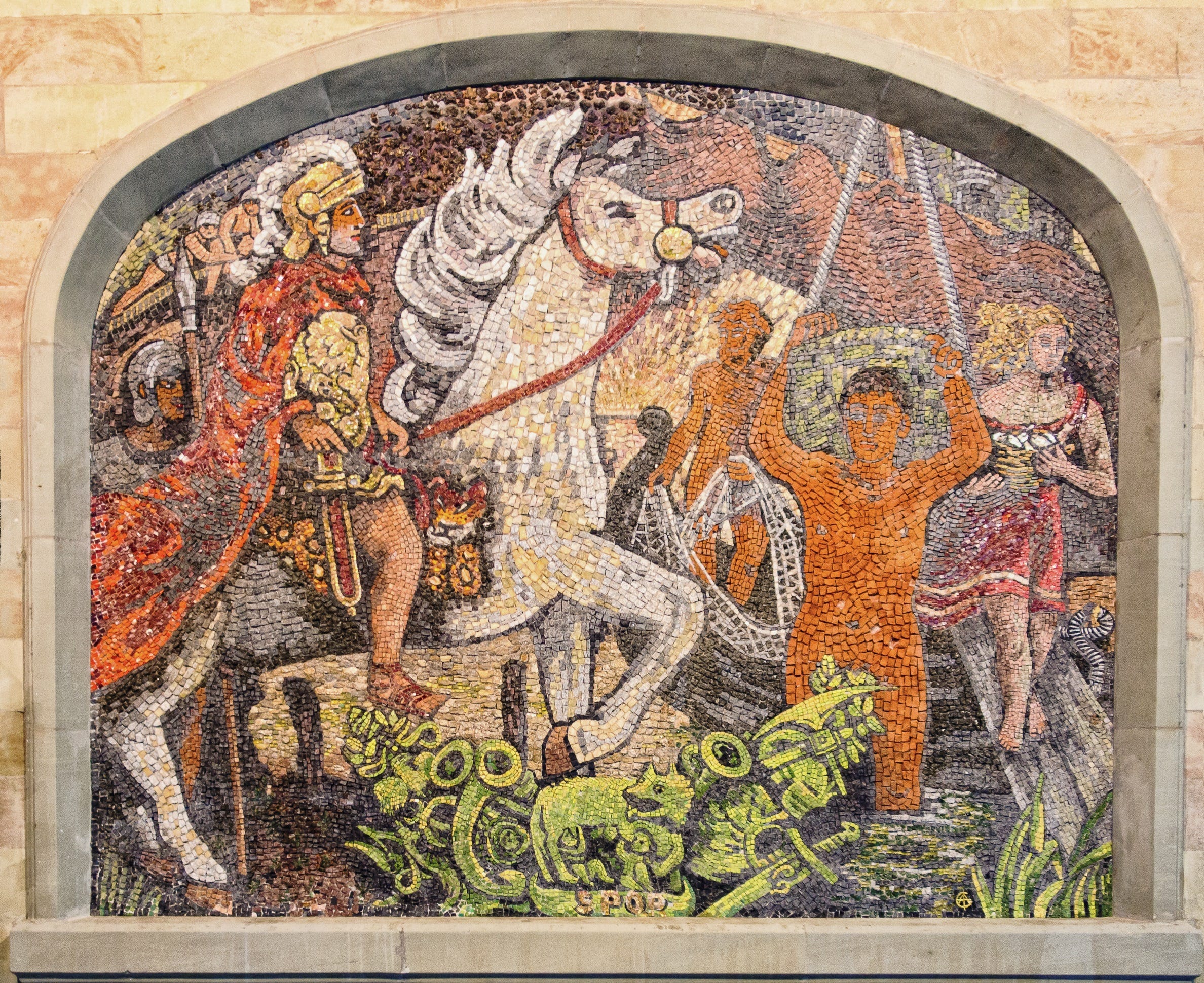
Centuries later, in the 16th century, Geneva would evolve from a contested border into a political experiment in motion. Tensions between the local bishop and the Dukes of Savoy created a vacuum. The Protestant Reformation in 1536 filled the gap. And with it came John Calvin. Under his influence, the city became a rigid, but radically hospitable, theocratic republic.
Between 1536 and 1560, over 20,000 refugees passed through its gates. A staggering number for a city of just 12,000 people. Those persecuted by dogma elsewhere in Europe found shelter here and the chance to keep existing.
Geneva, once a border, became a harbor. And refuge, a way of reinvention.
That impulse, to welcome the outsider and remake itself in times of crisis, never disappeared. It merely changed language, context, and historical frame. The gesture endured: Genevans learned over time that protecting the newcomer is also protecting the future self.
The Useful Fiction of Autonomy and the Ethics of the Backstage
By the end of the 18th century, as the French Revolution swept Europe with egalitarian fervor, Geneva was swallowed up. Annexed by France, it lost its independence for nearly two decades. When it regained sovereignty in 1813, it was politically drained and painfully aware that solitude could be fatal.
Two years later, in 1815, it made a fateful decision: to join the Swiss Confederation. But not as a continuous, coherent territory. Geneva became a patchwork: fragmented, yet stitched together by agreements. Bound not by geography, but by pacts. It discovered a core truth of its own survival: autonomy is a useful fiction, so long as it’s grounded in alliances.
This Genevan habit of negotiation, stitching, and survival lasted through the centuries. In the 20th century, it matured into an international vocation. In 1920, with the establishment of the League of Nations, Geneva became a laboratory for a radical idea: that countries could resolve conflicts without war. A multilateral rehearsal for peace, on a continent still trench-scarred.
The League ultimately failed, swallowed by the rise of totalitarianism and a second world war. But its structures remained. And with them, something deeper: a diplomatic culture, sedimented and almost organic, that defines Geneva to this day.
In 1948, the arrival of the World Health Organization and the International Committee of the Red Cross cemented this identity. Geneva didn’t merely host institutions. It became a city that learned to manage tension, turning neutrality into a form of listening and listening into a form of power.
Geneva has long embraced bold ideas, but almost always when pragmatism demanded it. And it has just as gracefully retreated when institutional morality came knocking. Its daring was never free. It was calculated. A survival tactic. A backstage ethic.
That ambivalence was especially visible between 1985 and 1995, when Europe was rocked by the HIV epidemic among intravenous drug users. While most countries followed repressive models, Switzerland, with Geneva and Zurich at the helm, made an almost unthinkable move: launching needle exchange programs, opening supervised consumption rooms, and putting survival before punishment.
It wasn’t an anti-moralist gesture. It was a tactical choice. And, perhaps because of that, profoundly ethical.
The data tells the story: drastic reductions in HIV infections, significant crime drops, consistent decline in drug-related violence. The improbable was working. Swiss policy, born of harm-reduction logic, became an international benchmark. Geneva, once again, wasn’t just following; it was leading.
What emerged was an applied ethics, a simple, almost brutal lesson in its clarity: lives aren’t saved with dogmas. They’re saved with data.
Geneva’s Mirror and Shadow
But Geneva’s past also reminds us that every ethic here carries its mirror and its shadow. Every gesture of progress echoes with a step back. Every radical act of listening is met with institutional deafness.
The same city that boldly led HIV harm-reduction policies in the 1990s now hosts a global discourse that turns its back on scientific evidence and leans, once again, on disguised moralism.
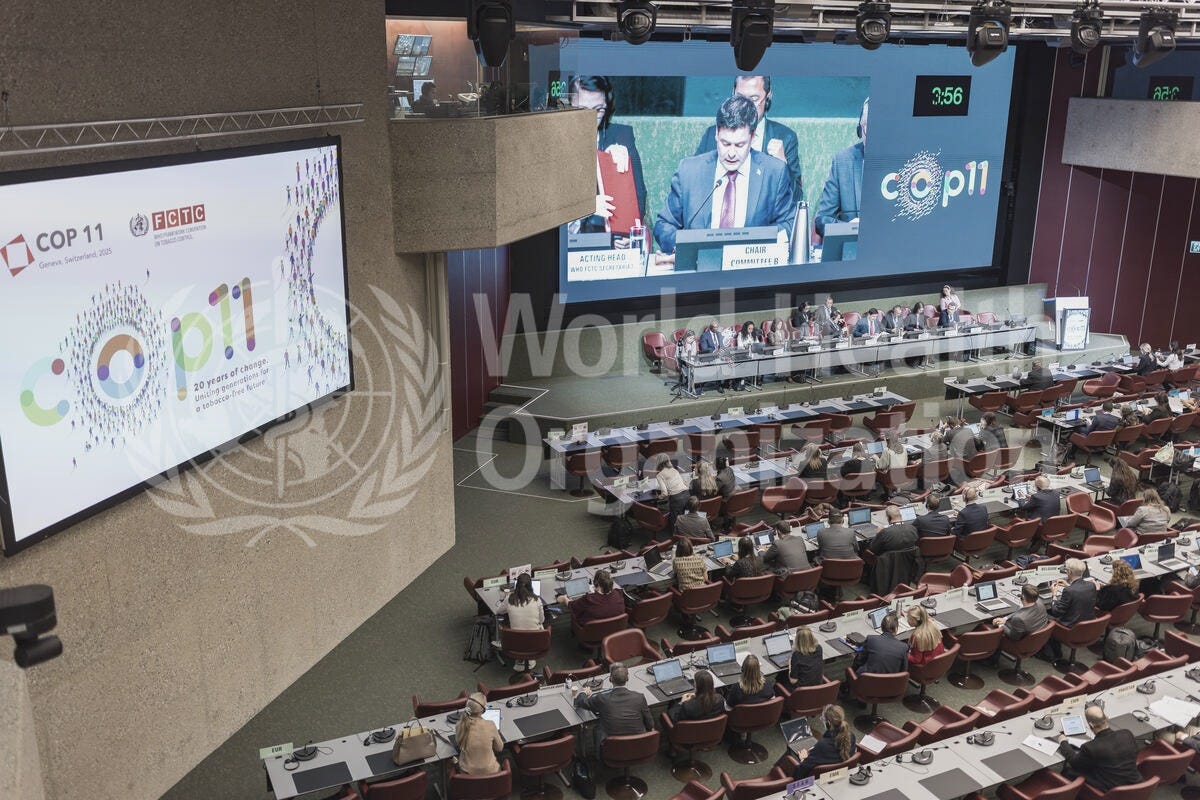
Inside the International Conference Center, where COP11 of the Framework Convention on Tobacco Control is being held, the prevailing logic isn’t that of pragmatic Switzerland, which traded syringes to save lives. It’s the logic of 16th-century Christendom, now wrapped in technical jargon.
Abstinence becomes a moral ideal.
Nicotine, a symbol of moral decay.
Less harmful alternatives, scientific heresies.
None of this is accidental.
The FCTC Secretariat often functions like a modern-day ecclesiastical court: decisions made behind closed doors, minimal transparency, dissent silenced, dogma enthroned before evidence.
Calvin would approve of the method, if not the subject.*
The city is split between data and dogma. Just look at Geneva’s human geography. On one side, the so-called Good COP: scientists presenting robust evidence, activists who survived smoking thanks to risk-reduction technologies, user organizations representing the very voices the city claims to value: those who live the consequences of policy.
This is the Geneva of dialogue, harm reduction, and pact-making.
But it’s outside the room.
Inside the official COP, the world turns as if those lives didn’t exist, as if the suffering they personify were not the raison d’être of policy, but an inconvenient distraction from doctrine. As if science should kneel before narrative, not the other way around. Within this closed moral architecture, dissent is treated not as a contribution, but as contamination. Decisions are not shaped by deliberation, but preserved, in the name of purity, not complexity.
It’s an old logic, updated: the same one once used against 16th-century religious refugees, 18th-century French workers expelled, or the Huguenot artisans who helped reinvent the city. Geneva welcomes when it must. It closes its doors when it fears losing control.
That’s its most persistent tradition: opening borders when survival demands it, and raising walls when power feels threatened.
The historical irony is almost too sharp to be accidental. In the same city that pioneered global harm-reduction policies for injectable drugs, now celebrated by the UN, stands the headquarters of the World Health Organization.
And it is that very WHO which, faced with tobacco, the world’s leading cause of preventable death, refuses to support the very logic that made Geneva a model: saving lives with data, not dogma.
The city that saved lives with clean needles now falls silent on clean nicotine.
The city, born as a haven for the persecuted, expels from its conferences the users who come to speak of survival.
The city that made negotiation its identity now makes silence its diplomatic protocol.
Now, past and present stare at one another, uncomfortably, across the quiet edges of Lake Geneva.
The Passage Yet to Open
At its core, Geneva has never stopped being what it was in 58 BCE: a narrow place, where life only continues when someone chooses to open a passage.
The difference is that today, in certain cases, the wall isn’t made of wood. It’s built from fortified reputations, opaque funding, and doctrines that mistake morality for public policy.
Inside, the FCTC Secretariat** operates as an autonomous fiefdom within the WHO, immune to critique and impervious to dissent.
The COPs no longer resemble political/scientific forums. They’ve morphed into rituals of legitimation, where consensus arrives shrink-wrapped, and dissent never makes it past security.
The doctrine is unmistakable, even when dressed in technical jargon: nicotine is the metaphysical enemy, lower-risk alternatives a “threat to youth,” and users mere infiltrators in service of the industry.
And so the question lingers, echoing through centuries, pandemics, and institutions: Which side does Geneva want to be on? The side that reduces harm to preserve life, or the side that reduces voices to preserve its own story?
The answer remains unsettled. And, as always, that dispute unfolds here in this improbable corner where global fate prefers to hide: among quiet cafés, sealed conference halls, and streets far too narrow for the weight of the conflicts they carry.
* The rhetoric of ‘industry interference’ functions as a doctrinal marker that, once invoked, suspends debate and legitimizes the exclusion of dissenting voices. Critiques or alternative approaches are disqualified a priori, with no real space for discussion.
** Though housed under the institutional umbrella of the World Health Organization, the Framework Convention on Tobacco Control (FCTC) occupies a space of its own, governed by rules that grant it an almost impermeable autonomy.
Its Secretariat does not answer to the bureaucratic machinery of WHO, but to a different center of gravity: the Conference of the Parties (COP), whose decisions shape not only direction but also the boundaries of what can be seen, said, or challenged.
Behind closed sessions, restricted observer access, and tightly controlled agendas lies an architecture built less of walls than of silences.
This insulation is not incidental: it is structurally reinforced by the very architecture of its funding. Resources flow from Parties and select private donors (see David Zaruk’s sharp analysis), sustaining a machinery whose primary accountability is not outward to plural constituencies but inward to its own normative loop. The result is an ecosystem where financial dependence and doctrinal closure reinforce each other, consolidating a governance model largely impervious to external scrutiny or conceptual dissent.
Together, these elements compose a model of governance that lends the Secretariat the semblance of an administrative fiefdom: a self-governing island of power within the multilateral system.