Silence as Policy
The liturgy of coldness in a continent that chews on formalities while swallowing its own hesitation
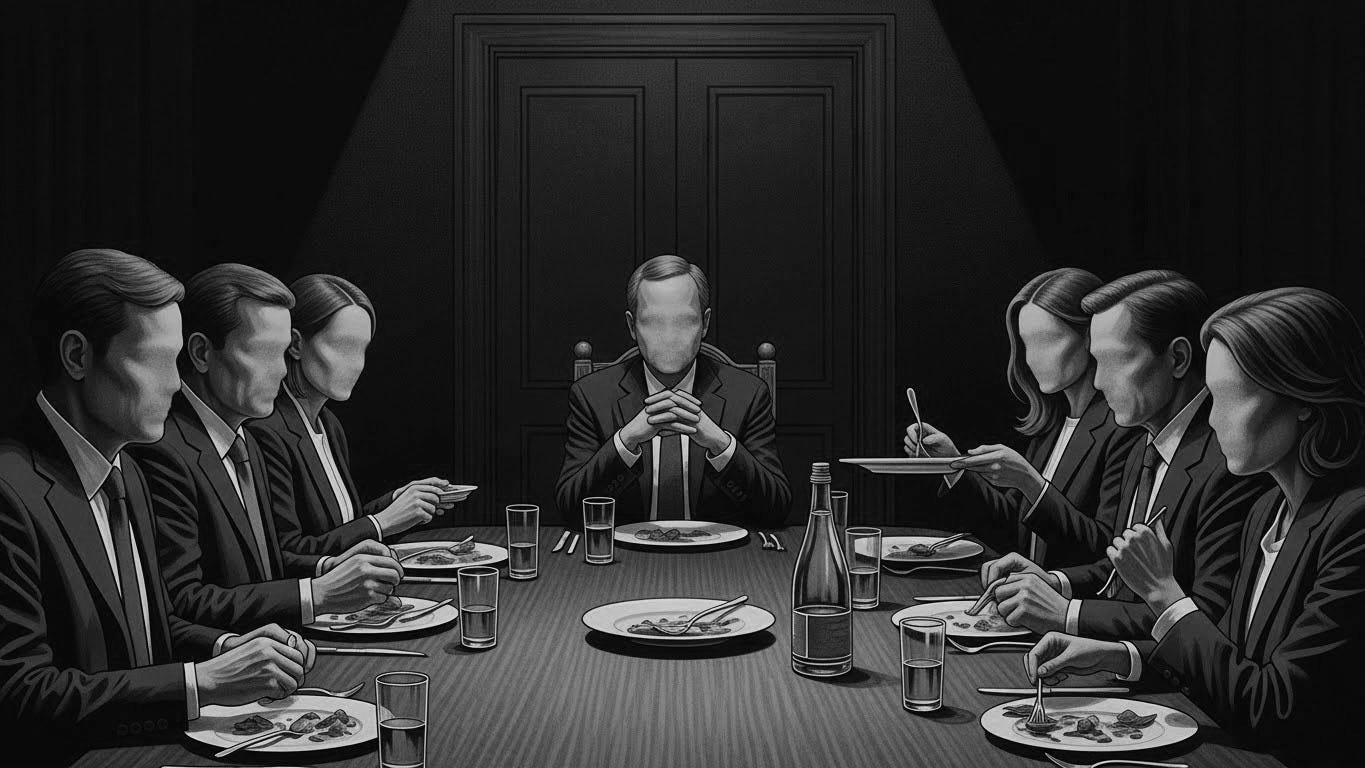
We have entered an era in which even silence leaves a trace. Recorded, archived, and transformed into evidence that nothing was said. And it is within this documented void that certain scenes recur.
Some moments speak more through repeated gestures than explicit intention. Bread. Sparkling water. A plate cooling slowly. The bubbles vanish against the glass, as if losing faith in a decision that will never come.
The table in Brussels resembles a controlled experiment: observe how long ministers can speak without actually meaning anything. The meeting is labeled “work,” but its rhythm is liturgical, a choreography of minimal gestures, nearly all of them dedicated to avoiding the discomfort of an honest sentence.
It is in this closed lunch session that ministers weigh words as though charting territory.
The room, neutral to the point of disappearance, seems designed to discourage any voice above the necessary.
A neutrality teetering on absence, silently asking that no one raise their tone.
The liturgy of coldness has become Europe’s chosen method for addressing problems too large to fit inside their impact assessments.
This was no mere staging. It was a metaphor. Diagnosis. European politics has been reduced to a sequence of lunches where everything is calibrated: time, temperature, tone, what is said, and, more importantly, what is avoided. A continent chewing on procedure while swallowing its own paralysis.
At that meeting, the choreography of consensus slid across the table: “protection of minors,” “smoke-free generation.” Clean formulas, labeled words, almost technocratic haikus revealing a deeper administrative fatigue: that of a Union speaking the language of public health while skirting its core dilemma.
Regulating nicotine is not just a sanitary policy; it is a declaration of what the State considers governable. In Europe’s tradition of biopower, the body has always been a site of moral dispute. Today’s hesitation is its heir. Nicotine and the millions who consume it remain the object no one wants to face head-on. To decide on it is to define the scope of the State itself.
Some gazes linger in the blind spot of a political project torn between exercising authoritarian discipline to rule and genuinely protecting lives.
And then, silence.
Not bureaucratic silence. But a dense, loaded quiet. The kind that descends when everyone knows what’s at stake and no one wants to write the first honest (and complex) sentence.
That silence carries an unspoken admission: to regulate nicotine is to decide who controls the narrative, the market, and the moral compass. No minister wanted to confess that Europe remains suspended between two models: the exhausted prohibitive stance, and harm reduction, whose name the Union still avoids.
In December, the method returned. The issue slipped back onto the agenda sideways, a conversation “among others,” pushed to the margins, away from direct light.
The paradox spoke for itself: the “informal” discussion had been recorded and published. Informal enough to dodge responsibility; formal enough to leave an archival trail. In Brussels, transparency often works like a film applied over the daily opacity.
Then, Belgium detonated the silence:
“Vapes aren’t about harm reduction—they’re about harm production.”
This was not a volatile argument. It was a warning. A slogan sculpted to cancel nuance and push any disagreement into the realm of moral suspicion. A moral frontier drawn to fence in debate.
Spain and France followed: flavor bans, online sales vetoed, packaging choked into sterility; not designed to inform, but to punish the gaze.
This was less public policy than performance. A competition of virtue and authority played out at the expense of the issue’s complexity; aimed less at real young people than at an abstract audience craving reassurance.
More restrictions, fewer nuances. And a stable refusal to admit what should already be evident: that simple policies applied to complex phenomena rarely deliver on their promises. Seldom protect those they claim to.
What these pronouncements silence matters as much as what they proclaim. By reducing the debate to a moral standoff, rescue defenseless children and confront a demonic industry, they avoid the real choice: What paradigm does Europe intend to follow? Absolute abstinence, despite its record of failure? Or harm reduction, which demands political courage, abandonment of dogma, and scientific honesty?
As ministers raise barriers in the name of youth, they treat available evidence as a methodological nuisance. Consensus isn’t born of data; it’s born of a desire to avoid political vulnerability.
And the unspoken subtext lingers: policies proclaimed to “protect children” may, in the end, push them toward precisely the markets the State does not control: the underground, the adulterated, the invisible.
The plate grows cold.
The bubbles go flat.
The European debate evaporates, without ever coming to a boil.
Employment, Social Policy, Health and Consumer Affairs Council. (2025, December 2). Public session – morning [Video]. Council of the European Union. https://video.consilium.europa.eu/event/en/28257