

Miami and the Trial Run for Nicotine’s Future
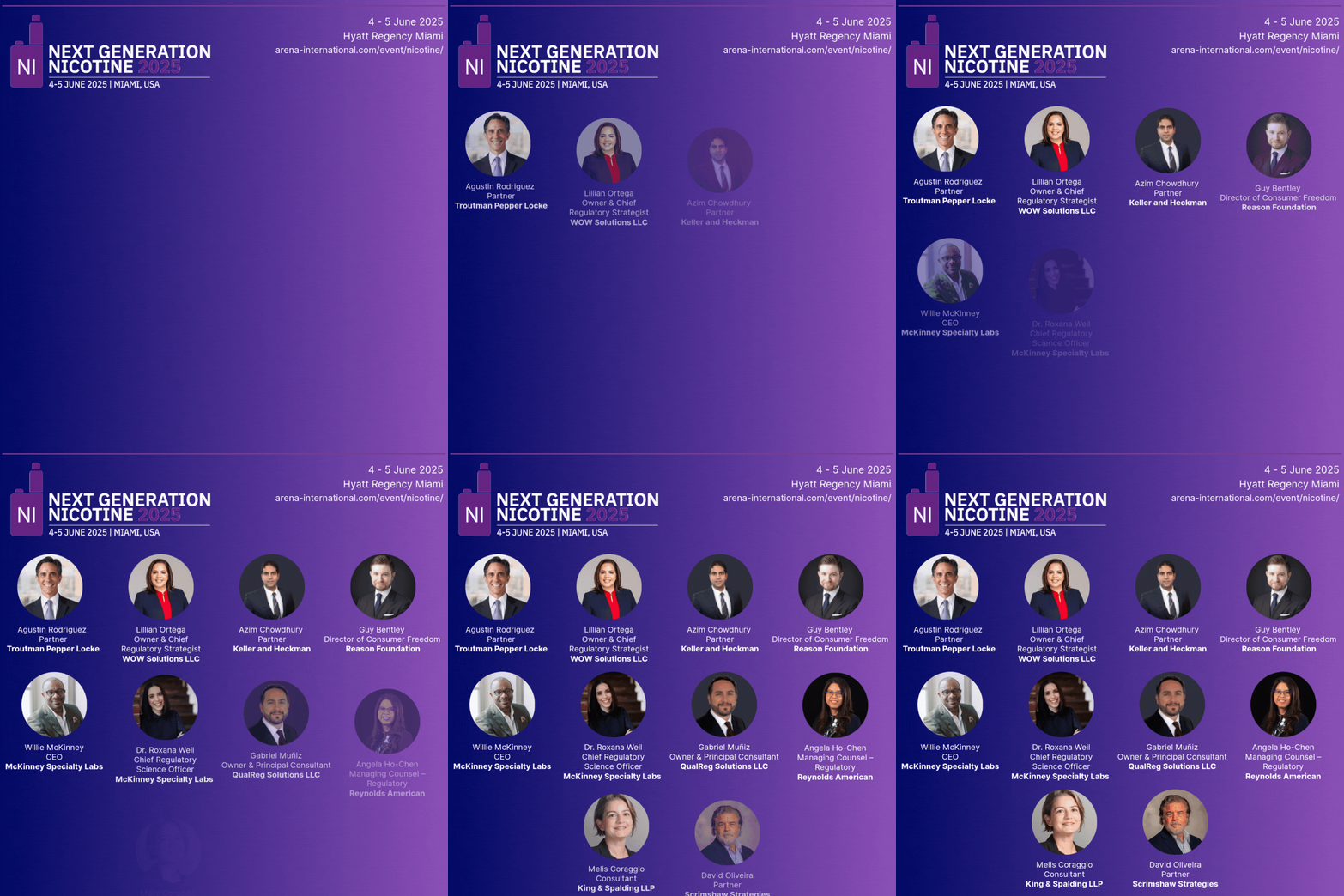
On June 4 and 5, the Next Generation Nicotine Delivery USA 2025 forum will hold its seventh edition in Miami. Over two intense days, as its organizers promise, a diverse constellation of players will come together to tackle the many fronts in the evolving nicotine market, including the FDA’s restructuring, new consumption formats, shifting legal frameworks, taxation, applied research, and the analysis of emerging trends.
But this gathering is more than just a sectoral conclave. It’s also a site of friction where meanings are contested — about risk, about regulation, about the right to access and choose. In a world where smoking continues to kill over eight million people a year — and where only a minority has access to lower-risk alternatives — the nicotine debate unfolds not only in laboratories but also in public narratives.
Forums, with their presentations, panels, and innovation-driven dynamics, don’t merely showcase products and technologies: they also sketch the symbolic and regulatory coordinates of what may or may not become a public health policy grounded in risk and harm reduction.
In this sense, Miami is not merely hosting a conference — it is hosting a collective trial run where governance, public perception, and the industry’s still-contested role in the transition toward fairer regulatory models converge. Beneath the technical and commercial scaffolding that structures the agenda, a quieter yet decisive dimension emerges: the politics of the risk continuum and the challenge of building public trust without reverting to old patterns of stigma.
Because talking about nicotine still makes people uncomfortable. And while devices evolve and legislation wavers, the adult consumer —the very person supposedly meant to be protected —remains largely absent from the heart of the narrative. Harm reduction is not just a technical imperative; it is an ethical, cultural, and political one. It demands that we acknowledge the lived experience of consumption, recognize its complexity, and challenge the moral monopoly that for decades has mistaken prevention for exclusion.
Amid an intensifying regulatory storm — fueled by litigation, emerging bans, and a divided public opinion — Miami isn’t just hosting an event: it embodies a historic tension. The forum positions itself as one of the few spaces where technical dialogue dares to brush up against the political — and where, however tentatively, new ways of governing uncertainty begin to emerge. Held at the Hyatt Regency, the gathering acts as an unofficial parliament, a place where frameworks are negotiated, narratives rewritten, and the meaning of “harm reduction” is redefined—with contradictions and blind spots—in an industry still shadowed by suspicion.
Science, Politics, and the Market: A Triangle of Unresolved Tensions
What sets this forum apart is not just who takes part, but what their often uneasy coexistence, frequently visible in hallway conversations, reveals. It’s an attempt, never simple but now unavoidable, to connect realms that have historically operated in parallel, if not in open conflict: those of science, public health policy, and the productive sector. In today’s context, such convergence is not only desirable — it’s structurally necessary for progress, provided it is grounded in evidence, transparency, and a clear commitment to the public interest.
Within a single space, traditional tobacco companies converge with tech startups focused on novel nicotine delivery methods, strategic litigation lawyers, and representatives from regulatory agencies. This diversity of actors not only reflects the ecosystem’s complexity but also exposes the difficulty and, at times, the resistance of building consensus when ethical, scientific, and commercial languages differ and respond to logics that rarely align.
Rather than dissolve the boundaries between disciplines, the forum makes them visible. And in that often tense exposure lies the possibility of imagining more honest, critical, and collaborative approaches to shaping public policies aimed at harm reduction. Because where disparate forms of knowledge meet without guaranteed dialogue, uncomfortable but essential questions emerge: How can we safeguard the autonomy of science against its growing instrumentalization? How can we ensure that regulation doesn’t merely mirror market logic, but serves as a genuine tool for health justice?
An Agenda Never Dodges Conflict: To Regulate Is Also to Decide
This edition’s agenda does not strive for neutrality or equidistance. It mirrors, with striking precision, the tensions of a sector where every regulatory decision is also a stance on risk, on protection, on the future of consumption. From the FDA’s new toxicological assessment methods to age-verification technologies blending biometrics and blockchain, what’s at stake is not just consumer safety, but also the legitimacy — and the limits — of a regulatory system in perpetual negotiation with itself.
Sessions on the PMTA process, post-market surveillance, and efforts to harmonize legal frameworks across countries are not merely technical; they are also strategic. They embody governance models and normative visions of what should be allowed, how it should be done, and for whom.
In this context, regulation can no longer be conceived as a neutral or purely legal instrument. It is a field of decision-making — one where certain forms of consumption are tolerated, certain products gain access to the market, and specific populations are prioritized — or excluded — from the landscape of possible care.
Yet amid these crucial definitions, a striking absence persists — one as meaningful as it is unsettling: the adult nicotine consumer. Too often reduced to a passive figure to be protected — or surveilled — they are rarely recognized as a legitimate interlocutor. Their experiences, histories, motivations, and rights are barely reflected in the dominant narratives as if consumer protection could function without the consumer’s consent, voice, or desire.
Here, regulation reveals its deepest dimension: as biopolitics — the management of bodies, addictions, and collective care. And like any form of life management, it distributes legitimacy, defines vulnerability, and shapes possible futures. Acknowledging this complexity does not delegitimize regulation — it demands that regulation be reimagined with greater transparency, greater equity, and yes, greater scientific rigor, but also with deeper listening to those who live, day by day, on the margins of that regulation.
Comparing Risks, Shaping Imaginaries: Science as Cultural Struggle
One of the most symbolically charged themes of this edition is the comparative analysis of risk, an exercise that transcends scientific objectivity to serve as a form of public pedagogy. To compare is not a neutral act. It draws the line between what is tolerable and what is unacceptable, between what can be integrated into daily life and what must be cast aside as the residue of an unjustifiable harm.
Evidence will be presented on the reduction of toxic compounds in devices like Ploom, compared to traditional cigarettes, as well as the case of Breeze Pro, which applies a component-based evaluation method in line with the FDA’s new guidelines. These practices reflect a legitimate effort to translate science into better products and smarter regulation. But they also expose a deeper tension: what do we now consider “acceptable risk”? By what criteria is that threshold set — and with whose voices, or silences, is it legitimized? Who holds the power to deem a risk acceptable when metrics intertwine with market interests? Or put differently: who gets to decide the threshold in a society that so often confuses profitability with legitimacy?
At the same time, companies like Greentank Technologies are announcing a technical shift in vape design: microfluidic chips replacing conventional heating coils. Beyond performance, this innovation aims to reposition the product as a symbol of progress, control, and technological refinement for an increasingly informed consumer base.
In this context, technology is not just a functional tool. It is also a cultural narrative — one that shapes decisions, builds trust (and distrust), and conveys values about health, autonomy, and the future. Understanding this symbolic layer doesn’t diminish the value of the product or the science behind it; on the contrary, it restores their ethical and social weight, lifting them from technocratic isolation and placing them in dialogue with the imaginaries that shape — and challenge — them.
Voices That Shape the Narrative: Authority, Power, and Legitimacy
In forums like this, the value lies not only in the content presented, but — perhaps more crucially — in who is authorized to present it. The narrative of risk, innovation, and regulatory futures isn’t built in a vacuum. It’s constructed through voices that carry not only technical expertise, but also institutional trajectories, ideological frameworks, and sectoral positions that explicitly or implicitly shape the boundaries of what can be thought, said, and done.
Among the key figures in this edition are: Dr. Charlene Liu, a risk analysis expert operating at the crossroads of applied science and strategic harm management; Dr. Derek Yach, former WHO official and a prominent advocate of pragmatic harm reduction over prohibitionist approaches; Dr. Vince Angelico, deeply versed in FDA regulations and pivotal in translating compliance into technical language; Tony Abboud, a vaping industry spokesperson offering a business perspective in an era of tightening regulation; Dr. Sarah Baxter-Wright, instrumental in Reynolds American’s shift toward lower-risk products; and Eric Gotting, a heavyweight jurist involved in litigation that has redefined the legal perimeter of the U.S. nicotine market.
Collectively, this lineup offers a sophisticated reading of today’s regulatory ecosystem, but it also reveals some glaring absences. The conspicuous lack of representatives from independent scientific institutions and adult consumer advocacy groups raises pressing questions about the forum’s participatory architecture: How can we discuss the legitimacy of public policy without the active voice of those who live with its consequences daily?
Because in these spaces, those who speak do more than inform — they establish reality. They grant legitimacy, delineate the contours of what counts as reasonable, and often render invisible other ways of understanding and governing consumption. In a domain so charged with ethical, epistemological, and political conflict, broadening the range of voices isn’t just a gesture of inclusion — it’s a demand for narrative justice—a fundamental condition for imagining more sustainable — and more democratic — solutions.
Youth, Surveillance, and the Battle Over the Right to Decide
Few issues ignite as much ethical and political tension as nicotine use among young people. This topic intersects legitimate public health concerns, moral anxieties, regulatory agendas, and technological promises — but it also activates a deeper debate: Where does protection end, and where does the exercise of power in the name of protection begin?
The forum will address this issue through proposals, such as those from IKE Tech and Innovative Technology, which promote age-verification systems based on biometrics and blockchain technology. These solutions aim to prevent underage access to points of sale. Still, they also raise critical questions: How do we balance protection, privacy, and autonomy in an era defined by algorithmic surveillance? To what extent can the defense of youth welfare justify the normalization of control technologies that could, tomorrow, be expanded to other bodies, other choices, other forms of consumption?
Because youth is not only a vulnerable group — it is, above all, a symbolic figure. A category that concentrates social aspirations, intergenerational fears, and strategies of governance. Often, it becomes the unquestioned foundation for policies that extend regulatory devices across much broader segments of the population. In its name, we legislate, restrict, and surveil.
A panel moderated by Willie McKinney promises to deepen this conversation by incorporating key geopolitical dimensions: from the UK’s vaping regulation to the Biden administration’s shift on menthol, with its profound racial implications, and recent court rulings that are reshaping the sector’s legal boundaries. Ultimately, what’s at stake is not just who gets access to nicotine, but who has the right to decide over their own body, and under what terms.
More Than a Forum: A Living Lab Prototyping Possible Futures
The event’s closing is far from incidental: a Shark Tank-style session where startups like Pixotine and AgeChecker.Net will pitch their proposals to a mixed jury blending regulatory expertise with market logic. This scene — fusing technical evaluation with competitive spectacle — doesn’t just celebrate innovation: it stages new forms of public legitimacy. In this context, “disruptive” risks becoming a synonym for “desirable,” and public health begins to speak the language of pitches rather than that of evidence, equity, or rights.
This forum is not merely a space for data exchange. At its core, it’s an experiment in contemporary governance — a testbed where technologies, narratives, regulatory frameworks, and potential futures are put on trial. Which models deserve public investment? Which products gain regulatory legitimacy? Which populations are prioritized, disciplined, or left out in the name of the common good?
Within this choreography of voices, metrics, and promises, nicotine ceases to be just a substance — it becomes a cultural battleground. A mirror in which our societies negotiate, not without irreconcilable tensions, across risk continuums, profit motives, individual autonomy, and access.
Because ultimately, the value of this forum lies not only in what is said, but in what is staged and symbolized: a still-imperfect, yet politically urgent, attempt to contest meanings around mitigated harm, collective responsibility, and the right to choose. Without prefabricated ideological trenches. With doubts. With contradictions. And with a science that, though cautious and often sidelined, does not flee from conflict, but inhabits it with integrity, with presence, and with honesty.